



Most containers sold in New Zealand end up as storage on a farm, a building site or a back section. For that use nobody checks the certification. It matters when the container will carry cargo on a ship again, when you buy it to move your own goods overseas, or when a buyer wants proof of its structural condition. This guide explains the CSC plate, what cargo worthy means, how a used container is recertified and what Biosecurity New Zealand checks on containers that arrive from overseas.
What the CSC plate is
The International Convention for Safe Containers, known as the CSC, was adopted by the International Maritime Organization in 1972. It sets structural and testing standards for freight containers and requires every container in international transport to carry a Safety Approval Plate. The plate is a small metal panel, usually riveted to the left-hand door.
The plate shows the country and reference of the approval, the date of manufacture, the manufacturer’s identification number, the maximum operating gross mass, the allowable stacking load and the racking test load. It also shows either the date of the next examination or an ACEP reference.
How long a CSC plate is valid
Under the Periodic Examination Scheme a new container must have its first examination within five years of manufacture and then at intervals of no more than 30 months. The next due date is stamped on the plate or on a decal beside it. Container owners with an Approved Continuous Examination Programme, known as ACEP, check their boxes at every major repair or interchange instead, and the plate carries the ACEP number rather than a date.
A one-trip container bought new comes with a fresh plate. A container retired from a shipping line usually still carries its plate, but the examination date has often passed, and the owner’s ACEP no longer covers it once it is sold out of the fleet.
When you need a valid CSC plate
- Shipping cargo by sea. A container loaded onto a ship must be CSC approved and within its examination date. Shipping lines and ports refuse units that are not.
- Moving your own goods overseas. If you buy a container to ship household goods to Australia or further, buy a cargo worthy unit with a current plate, or one the supplier will survey and plate before loading.
- Storage on land. No CSC is needed for a container that sits on your property as a store, workshop or site office. Councils look at the district plan and building rules, not the plate. See our guide to council consent.
Cargo worthy, IICL and wind and watertight
Cargo worthy, often shortened to CW, means a container is structurally sound enough to carry cargo by sea and could pass a CSC examination. IICL refers to the stricter inspection standard of the Institute of International Container Lessors, used when leased containers are returned. Wind and watertight means the box keeps weather out but may not meet the structural standard for shipping. Our guide to container grades compares these labels, and our buying checklist shows what to look at on the actual unit.
Recertifying a used container
A container with an expired plate can be surveyed again. An approved surveyor inspects the frame, corner posts, castings, floor, roof, doors and seals, and the container may need repairs before it passes. After a successful survey the plate is extended for up to 30 months under the Periodic Examination Scheme. Some NZ suppliers offer to survey and plate a used container on request, often for a shorter period on older stock. Ask for the survey report and the new examination date in writing, and allow for the survey fee and any repairs in your price.
Containers arriving in New Zealand
Every sea container that arrives in New Zealand falls under the Ministry for Primary Industries Import Health Standard for Sea Containers from All Countries, revised in July 2019. Containers must arrive clean, inside and out, and free of soil, plant material, insects, snails, animals and their eggs. Shipping lines complete a sea container quarantine declaration, and Biosecurity New Zealand can inspect, clean or treat a container before it is released. In the brown marmorated stink bug season, containers and cargo from some countries, including Italy, must be treated before they arrive.
If you import a container yourself, or buy one that has just come off a ship, these rules sit with the importer and the shipping line. Check the container is clean before it goes onto your property, and if you plan to send it overseas again, clean it thoroughly, because the destination country will apply its own biosecurity checks.
Need a container with a current CSC plate?
Tell us whether it is for storage or for shipping cargo, the size and your address. Suppliers who service your area quote cargo worthy or plated units where you need them.
Get a free quoteFAQ
Container certification: common questions
No. A container used only for storage on land does not need a valid CSC plate. The plate matters when the container will be shipped with cargo. For storage, check the condition of the doors, seals, floor and roof instead.
A CSC plated container carries a Safety Approval Plate under the International Convention for Safe Containers, with a current examination date or an ACEP reference. It is approved to carry cargo in international transport.
Not exactly. Cargo worthy describes the structural condition, and a cargo worthy container should pass a CSC examination. CSC certified means the container has a valid plate and examination date. Ask the seller which one you are getting.
Yes. Buy a cargo worthy container with a current CSC plate, or ask the supplier to survey and plate it before you load. Clean it thoroughly inside and out, because the destination country applies its own biosecurity rules.
Yes. Sea containers arriving in New Zealand must meet the MPI Import Health Standard for Sea Containers from All Countries. They must be free of contamination, and Biosecurity New Zealand can inspect, clean or treat them before release.
A high cube container is 305 mm taller than a standard one: 2.896 m outside instead of 2.591 m. Length and width stay the same. Those extra 30 cm make a big difference for some uses, such as homes, workshops and racking, and none at all for others. This guide compares the two heights, shows what the difference costs in New Zealand and helps you decide whether a high cube is worth it for your project.
Standard and high cube dimensions
Standard containers are often called GP (general purpose) or DV (dry van). High cubes are labelled HC or HQ on listings. Both come in 20ft and 40ft lengths.
| 20ft standard | 20ft high cube | 40ft standard | 40ft high cube | |
|---|---|---|---|---|
| External height | 2.591 m | 2.896 m | 2.591 m | 2.896 m |
| Internal height | about 2.39 m | about 2.69 m | about 2.39 m | about 2.69 m |
| Door opening height | about 2.28 m | about 2.58 m | about 2.28 m | about 2.58 m |
| Door opening width | about 2.34 m | about 2.34 m | about 2.34 m | about 2.34 m |
| Volume | about 33 m³ | about 37 m³ | about 67 m³ | about 76 m³ |
For the full set of lengths, widths and floor areas, see our shipping container dimensions page.
What the extra height gets you
The most useful gain is often the door, not the ceiling. A standard container’s door opening is about 2.28 m high; a high cube’s is about 2.58 m. That 30 cm decides whether a tall item goes through the doors at all. Inside, the extra height lets you stack pallets higher, fit taller shelving or a mezzanine, and stand up comfortably once a ceiling lining is installed.
When a high cube is worth it
Sleepouts, offices and container homes
Insulation and linings take height. A habitable container needs insulation in the ceiling and often under the floor as well, and Ruapehu District Council’s guidance on container conversions notes that high density polystyrene insulation products are generally needed to reach the H1 energy efficiency requirements inside a container. The H1/AS1 sixth edition reference building uses R6.6 for roofs, which is a lot of insulation to fit inside a steel box. In a standard container that build-up eats into a 2.39 m ceiling quickly; a high cube keeps usable headroom. That is why designers usually start container homes and sleepouts with high cube units. Our insulation guide covers the options.
Workshops
Overhead lights, a chain hoist, a roller door mechanism or tall machinery all need headroom. A 40ft high cube is the usual choice for a container workshop.
Racking and bulky storage
If you store on pallets, racking or shelving, the extra height adds roughly 12% more volume for the same footprint. For bulky items such as furniture, hay bales or tall equipment, check the door height first.
When a standard container makes more sense
- General storage of boxes, tools and household goods that will not be stacked to the ceiling.
- Buying used. Standard 20ft containers are the most common used unit in New Zealand, which gives you more choice and lower prices.
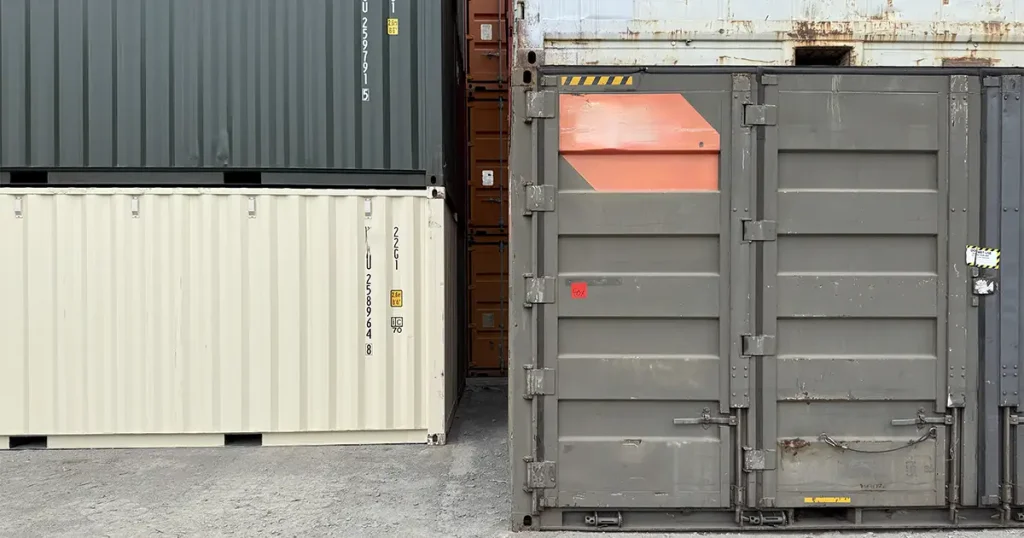
- Building a shelter roof between two containers, or joining containers. Heights must match, and owners of container builds report that matching heights and brands can be difficult. Buy both units at the same height, ideally from one supplier. See container shelters.
- Low overhead clearance on the delivery route or at the placement spot, such as power lines, trees or carports. A high cube on a truck stands about 30 cm taller.
What a high cube costs in New Zealand
In the Shipping-Containers.co.nz NZ price index, October 2026, a new 20ft high cube had a median asking price of $5,395 incl. GST across 13 listings, about $565 more than the $4,830 median for a new standard 20ft. For 40ft the comparison works the other way round: new 40ft containers on the NZ market are almost all high cubes, at $6,999 to $7,395 incl. GST for mainstream listings, and we found no published price for a new standard-height 40ft.
| Size | Standard height | High cube |
|---|---|---|
| 20ft new or one-trip | median $4,830 (n = 51) | median $5,395 (n = 13) |
| 20ft used | median $3,680, wind and watertight (n = 15) | few listings; one as-is unit at $3,278 |
| 40ft new or one-trip | no published price | $6,999 to $7,395 (n = 4, plus one at $10,595) |
| 40ft used, wind and watertight | $3,500 to $5,060 (n = 4) | $3,000 to $6,595 (n = 3) |
For a 20ft, the extra cost of a high cube is roughly 12% on the container price, and less once delivery is included. For a conversion that will be insulated and lined, that is a small share of the project. For plain storage, it may buy you height you never use.
Quick decision guide
- Choose high cube for sleepouts, offices, homes, workshops, tall machinery and pallet racking.
- Choose standard for general storage, used purchases on a budget, and anywhere it must match an existing standard container.
- For a new 40ft, expect a high cube unless a supplier confirms standard stock.
Compare the sizes on our high cube containers page. Our Australian site sets out standard vs high cube compared with photos of both. When you request quotes, state the height you need in your quote request, because HC and GP units are priced and stocked separately.
Ask for standard and high cube prices
Tell us the size, the use and the delivery address. Suppliers who service your area can quote both heights so you can see the real difference.
Get a free quoteFAQ
High cube vs standard: common questions
A high cube is 305 mm, or about 30 cm, taller than a standard container. Externally it stands 2.896 m high instead of 2.591 m. Internal height rises from about 2.39 m to about 2.69 m, and the door opening from about 2.28 m to about 2.58 m. Length and width are the same.
For homes, sleepouts, offices and workshops, usually yes, because insulation and linings take height and the taller door helps with large items. In October 2026 a new 20ft high cube cost a median of about $565 more than a standard 20ft incl. GST. For general storage that will not be stacked high, a standard container is normally enough.
HC and HQ both mean high cube, the 2.896 m tall version. GP stands for general purpose and DV for dry van; both describe a standard-height dry container at 2.591 m. You will see all four on NZ listings and invoices, often after the length, as in 20GP or 40HC.
Yes, but if you plan a shelter roof between them or want to join them, the height difference of about 30 cm complicates the build. Buy both containers at the same height where possible, ideally from the same supplier, and check whether the roof or joining work needs building consent.
They are hard to find. In October 2026 we found no published NZ price for a new standard-height 40ft, while new 40ft high cubes listed at $6,999 to $7,395 incl. GST. Container factories are concentrating production on 40ft high cubes. Used standard 40ft units are available, at $3,500 to $5,060 incl. GST in our data.
An empty 20ft shipping container weighs about 2.2 tonnes and an empty 40ft about 3.7 tonnes. High cubes weigh a little more, and small 8ft and 10ft units about 1 to 1.5 tonnes. Those figures matter for three practical decisions: which truck can deliver the container, what it should sit on, and how much you can safely load into it. This guide gives typical weights for every common size, shows where to find the exact figures on a container, and explains what the numbers mean on a New Zealand section, farm or building site.
Tare, payload and maximum gross weight
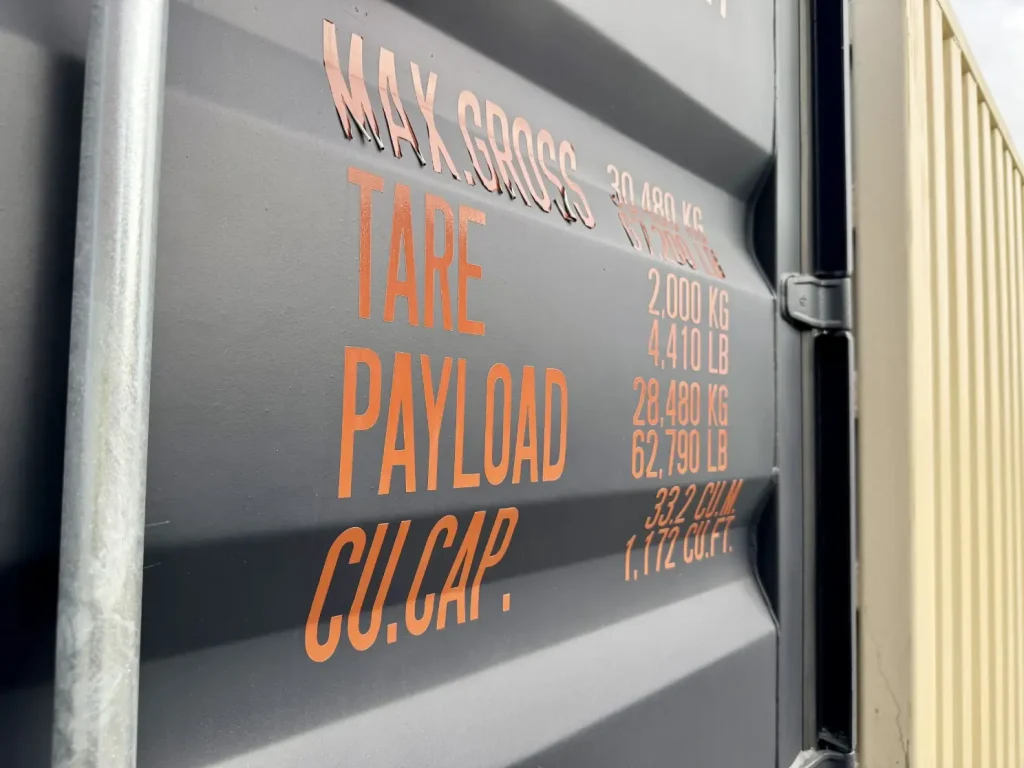
Every container is described by three weights, and they are printed on the right-hand door of most units.
- Tare weight is the weight of the empty container, including the floor and doors.
- Maximum gross weight is the most the container and its contents may weigh together, as certified for transport.
- Payload, sometimes marked as net or max cargo, is the maximum gross weight minus the tare. It is the most cargo the container is rated to carry.
The certified values sit on the CSC safety approval plate, a small metal plate usually riveted to the left-hand door. It also shows the manufacture date, which is useful when you compare used containers. Cut-down 8ft and 10ft storage units and heavily modified containers are no longer certified for freight, so their plates, if present, no longer apply.
| Container | Tare (empty) weight | Maximum gross weight | Approximate maximum payload |
|---|---|---|---|
| 8ft new-build mini | about 900 to 1,100 kg | not usually CSC-rated | ask the supplier |
| 8ft cut-down | about 1,000 to 1,300 kg | not rated after cutting | ask the supplier |
| 10ft | about 1,200 to 1,500 kg | about 10,000 kg where rated | about 8,500 to 8,800 kg |
| 20ft standard | about 2,150 to 2,350 kg | 24,000 kg (older) to 30,480 kg | about 21,700 to 28,300 kg |
| 20ft high cube | about 2,350 to 2,500 kg | usually 30,480 kg | about 28,000 kg |
| 40ft standard | about 3,650 to 3,800 kg | 30,480 to 32,500 kg | about 26,700 to 28,800 kg |
| 40ft high cube | about 3,800 to 4,000 kg | 30,480 to 32,500 kg | about 26,500 to 28,700 kg |
Why two containers of the same size weigh differently
Tare weights in the table are ranges because containers are not identical. Older units often have thicker floors or heavier doors, some factories use different steel gauges, and repairs add patches and welds. Modifications add weight quickly: a roller door, a personnel door with a steel frame, windows, insulation panels, lining, shelving and electrical fittings can add several hundred kilograms to a 20ft. Refrigerated and insulated containers are considerably heavier than dry containers of the same size because of their insulated walls and, on reefers, the refrigeration unit. If the weight matters for your site, ask the supplier for the tare figure painted on the door of the actual unit rather than relying on a typical value. Our dimensions page lists the matching sizes, door openings and volumes.
What weight means for delivery
Container deliveries in New Zealand use three types of truck, and weight affects each differently.
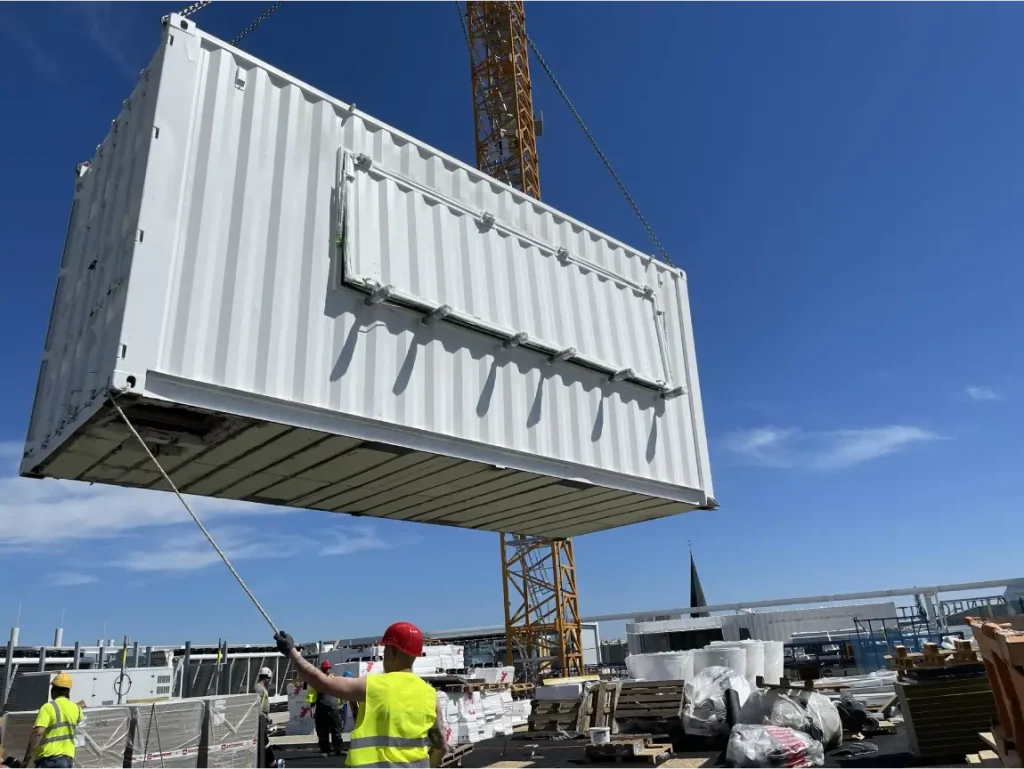
- HIAB crane trucks lift the container with a truck-mounted crane. Their capacity drops as the boom reaches further out, so a 2.2 tonne 20ft that is easy to lift close to the truck may be too heavy at full reach over a fence. That is why HIABs are mostly used for 8ft, 10ft and 20ft containers, and why suppliers ask how far the spot is from where the truck can park.
- Swinglifts (side loaders) lift with two cranes at the ends of the trailer and handle both 20ft and 40ft containers. They need a firm, level area alongside, because the stabiliser legs carry the load during the lift.
- Tilt trays slide the container off the back of the deck. Weight matters less for the lift, but the full truck still has to cross your ground.
The delivery truck usually weighs much more than the container it carries. Soft lawns in a wet winter, septic tanks, drainage pipes, shallow services and old driveways can all give way under a truck before the container is even unloaded. Mark them before delivery day. Our guide to HIAB vs swinglift delivery compares the trucks, and the transport cost guide explains how distance and access change the price.
Moving a loaded container
Suppliers deliver containers empty. If you want a loaded container moved later, for example when relocating a farm store or taking stored furniture to a new house, tell the transport operator the approximate weight of the contents. A container that weighs 2.2 tonnes empty can easily weigh 6 to 8 tonnes full of furniture or 15 tonnes or more with machinery and parts, which may need a different truck. Secure the load inside so it cannot shift while the container is tilted or lifted.
| Example | Total weight | Load per corner | Pressure on a 600 x 600 mm pad |
|---|---|---|---|
| 20ft, empty | about 2.25 t | about 0.56 t | about 15 kPa |
| 20ft with 8 t of household and garden storage | about 10.25 t | about 2.6 t | about 70 kPa |
| 40ft, empty | about 3.75 t | about 0.94 t | about 26 kPa |
| 40ft with 15 t of machinery and parts | about 18.75 t | about 4.7 t | about 128 kPa |
What weight means for foundations
A container stands on its four corner castings, so its whole weight passes through four small steel blocks. Set directly on soil, each casting presses a small area hard and sinks unevenly, especially after rain. Pads, sleepers or piers under each corner spread that load over a larger area, which is why a 600 mm square concrete pad under each corner reduces the pressure to the modest figures in the table. Council guidance on containers from Invercargill City Council and Grey District Council assumes good ground with an ultimate bearing capacity of 300 kPa. Peat, fill, clay that turns soft in winter and sloping sites need more care.
For storage, compacted gravel, concrete pads or treated timber sleepers under the corners are normal, with a slight fall towards the doors for drainage. MBIE noted in Determination 2014/030 that shipping containers are inherently stable even when empty and that a container simply placed for storage does not need foundations. A container that people live or work in, one stacked on another, or one set on a deck, retaining wall or raised piles is different: it needs engineered foundations and fixings, and usually building consent. Our foundations guide compares gravel pads, piers, sleepers and slabs.
Weight, wind and tie-downs
An empty 20ft weighs little for its size and presents a large flat side to the wind. Sites in New Zealand’s high and very high wind zones, exposed ridgelines and coastal sections deserve extra thought, especially for empty containers or two containers with a roof between them. Your council can tell you the property’s wind zone, and BRANZ explains wind zones under NZS 3604. Engineered hold-downs are expected for occupied, stacked or raised containers and for container shelters.
How much can you load inside
For storage, the floor usually limits you long before the rated payload does. Container floors are tested to carry the axle load of a forklift working inside, so spread heavy items over the floor rather than stacking them in one spot, keep the heaviest items low, and load over the cross members near the walls where you can. If you plan to store machinery, pallets of stone, steel or anything over a few tonnes, tell the supplier when you request a quote so they can recommend a suitable unit and floor condition.
Need a container placed somewhere tricky?
Tell us the size, the delivery address and how far the spot is from where a truck can park. Suppliers who service your area will check the weight and reach before they quote.
Get a free quoteFAQ
Container weight: common questions
An empty 20ft standard container weighs about 2,150 to 2,350 kg, roughly 2.2 tonnes. A 20ft high cube weighs about 2,350 to 2,500 kg. Modern 20ft containers are rated to a maximum gross weight of 30,480 kg including cargo, and older units to 24,000 kg. The exact tare is printed on the door and on the CSC plate. See the 20ft containers page for sizes and prices.
An empty 40ft standard container weighs about 3,650 to 3,800 kg and a 40ft high cube about 3,800 to 4,000 kg. Maximum gross weight is usually 30,480 or 32,500 kg, which leaves a payload of roughly 26.5 to 28.8 tonnes. Delivery is normally by swinglift because of the length and weight. See the 40ft containers page for prices and access.
Large HIAB trucks can, but it is unusual. A 40ft weighs about 3.7 tonnes empty and is 12 metres long, and a crane’s capacity drops quickly as it reaches out. Most 40ft deliveries in New Zealand use a swinglift, which lifts from both ends of the trailer. If only a HIAB can reach your site, tell suppliers so they can check a suitable crane is available.
On paper a modern 20ft can carry about 28 tonnes of cargo and a 40ft about 26.5 to 28.8 tonnes, as long as the load is spread evenly and secured. For storage on your property, the practical limits are the floor, the ground under the corners and how the container will be moved later. Heavy loads concentrated in one spot can damage the floor well below the rated payload.
A container placed for storage on level ground is generally stable, and MBIE has described containers as inherently stable even when empty. Engineered hold-downs are expected for containers people live or work in, stacked or raised containers, units on piles, and container shelters with a roof. Exposed sites in high wind zones deserve a check with an engineer even for storage.
A sleepout is a detached bedroom used together with the main house, without its own kitchen. Containers suit the job because they arrive as a weathertight, lockable box. Whether you need a building consent depends on the container’s size, how much you modify it, whether it has plumbing, and how close it is to boundaries. Councils also take different views on habitable containers, so treat this guide as preparation for a conversation with your council, not a substitute for it. The rules below are as at October 2026.
The exemptions that can apply
Schedule 1 of the Building Act exempts some small detached buildings from building consent. Since 23 October 2025, under the Building (Exempt Roof-mounted Solar Panel Arrays and Building Work) Order 2025, buildings up to 10 m² have no boundary distance condition, and buildings of 10 to 30 m² must be at least 1 m from any boundary or residential building (MBIE summary).
| Container | Approx. floor area | Possible route | Notes |
|---|---|---|---|
| 10ft | 7.3 m² | Clause 3 (up to 10 m²) | Sleeping allowed only if used with a dwelling and no cooking facilities. No boundary condition. |
| 20ft | 14.8 m² | Clause 3B (LBP) or 43 (engineer-reviewed design) | 1 m from boundaries and residential buildings. Clause 3A requires lightweight products, which a steel shell is not. |
| 40ft | 29.7 m² | Clause 3B or 43 | Just under 30 m². A deck roof or lean-to can push it over. |
| Two joined units | Over 30 m² | Building consent | Joining containers is building work. |
What the exemptions rule out
- No sanitary facilities and no storage of potable water. A toilet, shower or basin takes the building outside the exemption, and building.govt.nz notes that plumbing still needs consent.
- No cooking facilities if people sleep in it.
- Single storey only: floor no more than 1 m above the ground and no more than 3.5 m high above the floor.
- Clause 3A also requires smoke alarms where there is sleeping accommodation; fit them whichever route you use.
Exempt work must still comply with the Building Code under section 42A. Exempt does not mean unregulated: openings, framing and ventilation still have to be right, and electrical work must be done by a licensed electrician, who provides an electrical safety certificate.
How councils see container sleepouts
Grey District and Invercargill council guides list a sleepout without cooking among the occupied uses that need building consent, and Whangārei District Council requires consent for any use other than storage. Those guides were written before the October 2025 changes, and work that genuinely fits a Schedule 1 exemption does not need council approval, but they show how councils approach containers. A modified container is also not a typical lightweight building, so expect questions. Ask the council for its view before you cut steel, and consider a discretionary exemption under clause 2 or a full consent if the answer is unclear. Our container consent guide covers the determinations behind this.
The district plan applies too: yards, coverage and overlays. The national standard for minor residential units does not cover sleepouts that are not self-contained, so ordinary zone rules apply. Letting a sleepout to paying guests is a different activity; Crux reported a $12,000 fine in the Queenstown Lakes district for containers converted for visitor accommodation without consents.
Making it comfortable and dry
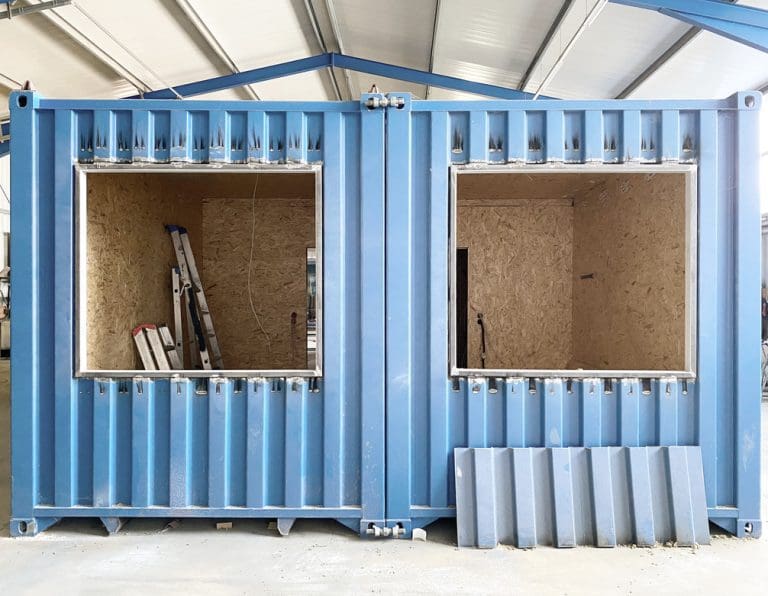
A bare steel box is cold in winter, hot in summer and wet inside on cool nights, because water condenses on the underside of the roof. People sleeping in a small space add moisture every night. Plan these items from the start:
- Insulation on walls, roof and floor with a vapour control layer. Closed-cell spray foam and insulated panels are the common choices; compare them in our container insulation guide.
- Ventilation and light. Ruapehu District Council’s container guide cites natural light of at least 10% of floor area and opening windows of at least 5% for habitable containers.
- Headroom. Linings and ceiling insulation take height, so a 20ft high cube with about 30 cm more height is the usual choice.
- A level, stable base. Clause 3 and 3B buildings still need adequate support and, on exposed sites, tie-downs.
- Condensation control for the first weeks while linings dry; our condensation guide explains why containers sweat.
Colour matters more than many expect. Our field study measured temperature and humidity in five containers, and the video below shows how much hotter dark units run.
A sensible order of work
- Decide the size from the bed, storage and door positions; a 10ft container suits a single bed, a 20ft a double with storage.
- Confirm the exemption route or consent with the council, and check district plan yards.
- Choose a new or one-trip shell for a clean interior and floor.
- Get openings, insulation and linings designed together.
- Book the electrician early.
- Request quotes for the container and delivery, noting where the truck can stand.
If you want a bathroom or kitchenette, you are building a small dwelling: see the granny flat exemption and container tiny homes.
Ready to price a sleepout shell?
Send us the size, condition and delivery address. Suppliers in your area quote directly, including delivery.
Get a free quoteFAQ
Container sleepout questions
It depends on size, modification and services. A 10ft container under 10 m² may fit clause 3 if it has no plumbing or cooking and is used with a dwelling. A 20ft or 40ft needs clause 3B or 43, which require an LBP or an engineer-reviewed design and 1 m from boundaries, or a full consent. Some councils treat any habitable container as needing consent, so ask first.
Not under the small building exemptions. Clauses 3, 3A, 3B and 43 exclude sanitary facilities and potable water storage, and plumbing and drainage need a building consent. A sleepout with a bathroom is closer to a minor dwelling, which follows the granny flat rules or a full building consent. Plan for occupants to use the main house bathroom if you want to stay exempt.
For an exempt building of 10 to 30 m², at least 1 m from any legal boundary and from residential buildings, including your own house. Under 10 m² there is no Building Act distance since 23 October 2025. The district plan may require a larger yard, so check your zone before you place the container.
Letting to paying guests or tenants changes the use, which can bring building consent, fire safety and district plan requirements for visitor accommodation or a separate residence. In the Queenstown Lakes district a $12,000 fine was reported for container visitor accommodation built without consents. Talk to the council before advertising.
In practice, yes. Without insulation the steel shell drops below the dew point on cool nights and water drips from the roof, and the room swings between cold and hot. Exempt buildings must still meet the Building Code, including moisture and ventilation requirements. Insulated walls and roof with a vapour control layer, opening windows and a heat source keep it usable year round.
Shipping containers are built from weathering steel, usually sold under the name Corten, and finished with a marine paint system. Many buyers assume the Corten protects itself. Near the New Zealand coast it does not. This guide explains how containers rust, how the BRANZ exposure zones apply to your site, why Rotorua and other geothermal areas are a special case, and how to inspect, treat and paint a container so it lasts.
Where containers rust first
Rust starts where the paint is broken or where water sits. On a container that usually means:
- Roof panels with dents that hold rainwater.
- Scratches from twistlocks, forklifts and crane chains.
- The lower door frame and the steel behind worn door gaskets.
- Corner castings and corner posts, where paint chips during handling.
- The bottom side rails, where dirt, leaves and moisture collect.
- Cut edges around doors, windows or vents added later.
What Corten can and cannot do
Weathering steel forms a dense rust layer, called a patina, that slows further corrosion. BlueScope’s technical bulletin on REDCOR weathering steel explains that the patina only forms with bold exposure, regular wetting and drying, and limited contact with airborne chloride. It states plainly that “there is no advantage to using weathering steels (compared to plain carbon structural steels) for marine applications”. It also notes that painted weathering steel can give better paint life.
For a container near the sea, the paint system is what protects the steel. Keeping that paint intact is the whole job.
| Zone | Description | What it means for a container |
|---|---|---|
| B (low) | Inland areas with little risk from wind-blown sea-spray salt | Standard care: touch up damage and check the roof once a year |
| C (medium) | Inland coastal areas with medium risk | Wash sheltered areas and check the paint every 6 to 12 months |
| D (high) | All areas within 500 m of the coast including harbours, 100 m from tidal estuaries and sheltered inlets, and all offshore islands | Faster paint breakdown at scratches, dents, seals and castings; wash every 3 months, use stainless fixings |
| E (severe marine) | Breaking-surf beachfronts (E2/AS1 only) | Plan regular recoating and frequent washing |
Find your exposure zone
BRANZ Maps shows the indicative exposure zone, wind zone and earthquake zone for any NZ address. Much of the Auckland isthmus and Dunedin sits inside the 500 m zone D band, as do Mount Maunganui, Pāpāmoa and the harbour edges in Tauranga. BRANZ also records wind-carried salt more than 20 km inland, so a site outside zone D is not free of salt.
The NZ Metal Roof and Wall Cladding Code of Practice treats the south coast of the North Island as a particularly harsh marine environment because of strong onshore winds and salt-laden air. If you are placing a container in Wellington, especially on the south coast, plan for coastal maintenance from the first year. Local notes for Auckland cover the harbour suburbs.
Geothermal corrosion in Rotorua
Geothermal air is harder on steel than sea air. BRANZ field trials in Rotorua, published as study report SR393, measured first-year corrosion of mild steel at about 3,302 g/m² per year near Sulphur Bay. That is around five times the 650 g/m² recorded at a severe marine test site at Oteranga Bay. Zinc, the coating on galvanised steel, also corroded faster than at the marine site. The early corrosion products did not protect the metal, and attack accelerated sharply once hydrogen sulphide rose above about 1 part per billion. Levels of 31 to 41 ppb were measured.
The Code of Practice treats buildings within 50 m of a fumarole, and much of Rotorua generally, as a geothermal microclimate, and BRANZ has proposed moving parts of the Bay of Plenty geothermal area from zone B to zone C. In Rotorua or on other geothermal ground, inspect the paint more often than you would on the coast and repair damage quickly. Our Rotorua page covers local supply and delivery.

Surface rust, scale and holes
- Surface rust: orange staining or light bloom at scratches and on the paint film. Cosmetic if treated early.
- Scale: flaking layers that lift when scraped. The steel underneath is losing thickness.
- Perforation: holes, or steel that a screwdriver pushes through. That section needs cutting out and new steel welded in.
Check the roof, the top and bottom side rails, the lower door frame and the corner castings first. Push a screwdriver into suspect spots on the base rails and cross members. When you buy used, read the grade description carefully; our guide to container grades explains what rust each grade usually allows, and the buying checklist covers the rest of an inspection.
Treating rust and repainting a container
- Wash the container with fresh water to remove salt and dirt. Salt left under new paint makes it fail early.
- Remove loose rust and flaking paint back to firm material with a wire brush, grinder or abrasive blasting.
- Prime bare and rusted steel with a primer suited to the surface, such as a zinc-rich or surface-tolerant primer, following the manufacturer’s instructions.
- Apply a topcoat system rated for your exposure, ideally a marine or industrial grade product, at the film thickness the manufacturer specifies.
- Seal cut edges and new penetrations, and replace damaged door gaskets.
Paint life depends heavily on exposure. BRANZ notes that coatings rated for 10 to 15 years in medium environments may last only 2 to 5 years in very high industrial or marine conditions. Ask the paint supplier for a specification matched to your BRANZ zone, and choose a lighter colour if heat inside the container matters to you.
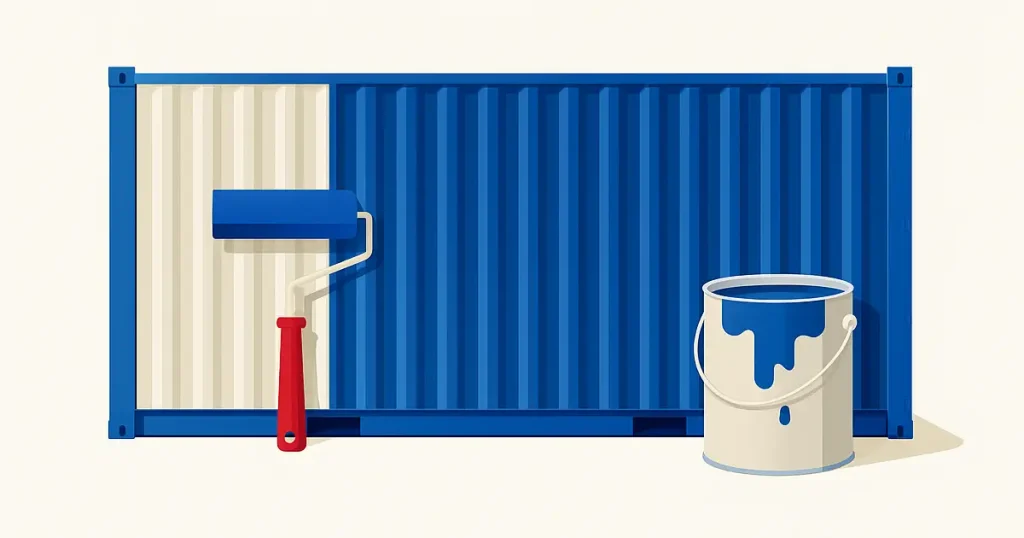
Placement and maintenance that slow corrosion
- Set the container on sleepers, concrete pads or piers under the corner castings so air moves under the base and the bottom rails can dry. Our guide to container foundations compares the options.
- Give it a very slight fall along its length so the roof drains rather than ponding.
- Wash sheltered surfaces. BRANZ reports that sheltered, unwashed surfaces collect about 3 to 8 times more salt. One cladding manufacturer recommends washing every 3 months in the most severe environments, and 6-monthly or yearly elsewhere.
- Use stainless steel fixings for anything you attach. In zone D, NZS 3604 requires structural fixings (other than nails and screws) to be at least grade 304 stainless; grade 316 is the better choice right on the coast.
- Control condensation inside with vents and moisture absorbers, as rust also starts on the underside of the roof. See our condensation guide.
- Touch up scratches as soon as they appear.
A well maintained container on a coastal section can still give many years of service. Our guide on how long shipping containers last sets out a full maintenance schedule. If you are buying for a site within 500 m of the sea, a container with sound paint is worth the extra cost; ask suppliers about paint condition in your quote request.
Buying for a coastal or geothermal site
Tell us the delivery address and how close it is to the sea or geothermal ground. Suppliers who service your area can quote a container with paint suited to the site.
Get a free quoteFAQ
Container rust: common questions
Yes. Containers are made from weathering steel with a paint system on top, and rust starts wherever that paint is broken or water sits, such as roof dents, scratches, door frames and corner castings. Weathering steel does not protect itself in marine air, so near the coast the paint does the work and needs regular care.
No. Corten forms a protective patina only under bold exposure, regular wetting and drying and limited airborne salt. BlueScope’s technical guidance states there is no advantage to weathering steel over plain structural steel for marine applications. On a container, the factory paint system is the main protection, so keep it intact.
Zone D is the high exposure zone used in NZS 3604. BRANZ describes it as all areas within 500 m of the coast including harbours, 100 m from tidal estuaries and sheltered inlets, and all offshore islands. In zone D, structural fixings other than nails and screws must be at least grade 304 stainless steel. You can check your address on BRANZ Maps.
Set it on sleepers or pads so the base stays dry, keep the roof free of standing water, wash off salt regularly, and touch up scratches as soon as they appear. When rust does start, take it back to firm steel, prime it and apply a topcoat rated for your exposure zone. Control condensation inside with vents and absorbers.
Often, yes. BRANZ trials in Rotorua measured first-year corrosion of mild steel near Sulphur Bay at about five times the rate at a severe marine test site, driven by hydrogen sulphide in geothermal air. Zinc coatings also corroded faster. In geothermal areas, inspect and repair the paint more often than you would on the coast.
Yes, with the right preparation. Wash off salt, remove loose rust and flaking paint, prime bare steel and apply a topcoat system suited to metal and your exposure zone, at the thickness the manufacturer specifies. Painting over loose rust or salt fails quickly. On coastal sites, ask the paint supplier for a marine or industrial grade specification.
Auckland Council is a unitary authority. It issues building consents and runs the Auckland Unitary Plan (Operative in part), which has been the region’s district plan since 15 November 2016. Our research found no Auckland rule written specifically for shipping containers, either in the Unitary Plan or on a council guidance page, as at October 2026. A container is therefore assessed like any other building or accessory building: under the Building Act for building work, and under the Unitary Plan for where it sits and what it is used for. This guide explains how that works on Auckland sections, lifestyle blocks, business yards and building sites. Confirm your own address with Auckland Council before you order.
Building consent in Auckland
The national rules apply unchanged. Placing an unmodified container on your property for storage is not building work, so no building consent is needed; MBIE found in Determination 2014/030 that foundations are not required for a container simply placed. Consent questions arise when you add a formed slab or piers with hold-down fixings, cut openings, add a roof between containers, connect services or use the container as a sleepout, office or dwelling. Our national guide to building consent for shipping containers explains the Schedule 1 exemptions, including the 23 October 2025 change that set a 1 m boundary distance for exempt buildings of 10 to 30 m² and removed it for those under 10 m².
How the Unitary Plan treats a container
Expect the council to test a container against the standards of your zone and any overlay, in the same way as a garden shed or garage. The standards that most often matter are:
- front, side and rear yards, and height in relation to boundary
- building coverage and impervious area limits on residential sites
- Special Character Area and Historic Heritage overlays, which can add controls on new buildings
- coastal and natural hazard overlays on waterfront and low-lying land
- yard and screening rules where a business site adjoins a residential zone
Residential zone standards in Auckland have changed with intensification rules and later RMA amendments, so figures quoted online can be out of date. Check the current standards for your zone in the Unitary Plan text and maps rather than relying on summaries.
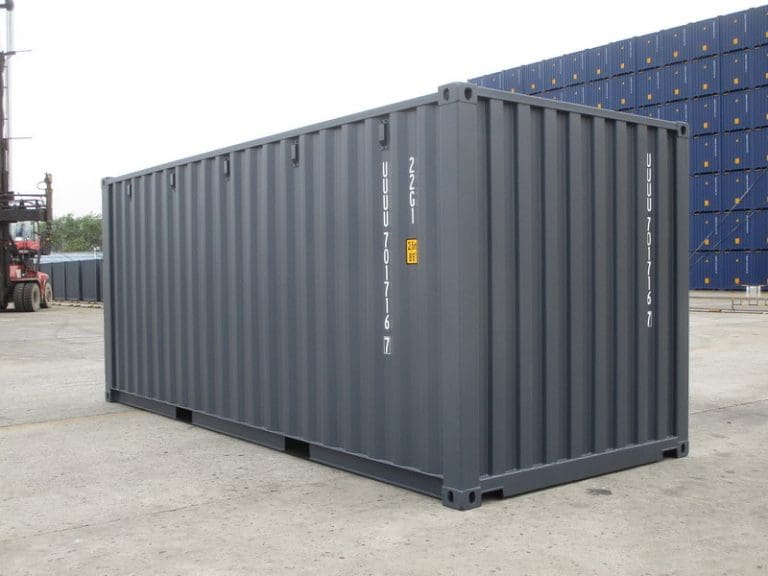
| Site | Building consent | Unitary Plan checks |
|---|---|---|
| Suburban section, storage only | Not needed for an unmodified container on sleepers or pads | Yards, height in relation to boundary, coverage |
| Character or heritage street | As above | Special Character or Historic Heritage overlay, visibility from the street |
| Waterfront or coastal section | As above | Coastal and hazard overlays; plan for salt exposure |
| Rural or lifestyle block (for example Kumeū, Dairy Flat, Pukekohe) | As above; farm sheds with roofs may need consent | Rural zone yards, often larger than in town |
| Business or industrial yard | Needed for offices, workshops and stacked or fixed units | Yards and screening next to residential zones |
| Building site | Site offices with services need checking | Usually covered by the project; road use needs Auckland Transport approval |
Containers on the road, footpath or berm
Auckland Transport manages Auckland’s roads. AT states that anyone planning work affecting the road, footpath or berm must apply for a Corridor Access Request (CAR). Placing a container on an Auckland road, footpath or berm therefore needs AT approval, generally through a CAR with a traffic management plan. We could not confirm a specific AT fee or permit page for containers, so allow lead time, check whether your job needs a CAR and confirm current AT fees before the truck is booked. Delivery to the kerb and then off the road onto the property, without leaving the container on legal road, avoids most of this.
Auckland conditions that affect a container
NIWA’s Auckland climatology records average 9 am relative humidity from about 79% at Leigh to 88% at Ardmore. That makes condensation the most common complaint from Auckland container owners, so read our guide to stopping condensation in a container before you load furniture or tools. Wind matters too: Auckland Airport averages about 55 days a year with gusts over 63 km/h, and Warkworth about 90. An empty container on an exposed ridge or a stacked pair needs engineered tie-downs if it becomes a building.
Much of the isthmus lies within 500 m of a harbour or the coast, which BRANZ classes as exposure zone D. Expect faster paint breakdown at scratches, door seals and corner castings, and use stainless fixings. Our coastal corrosion guide covers maintenance.
Intensification is the other Auckland factor. Knowledge Auckland reports 15,017 dwellings consented in the year to October 2025, with 70% of October 2025 consents being multi-unit homes. Tight townhouse sites leave little room for a container, a truck or a crane’s outriggers, so measure before you buy.
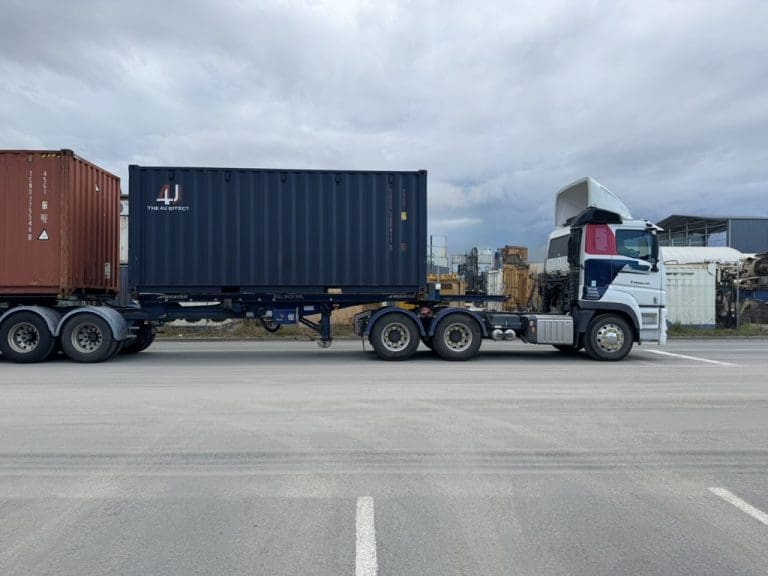
Getting a container to an Auckland site
Containers reach Auckland by sea at the Port of Auckland‘s Fergusson container terminal, or by rail from Tauranga into MetroPort at Southdown, which Port of Tauranga describes as New Zealand’s fourth largest container terminal. The Wiri inland port in South Auckland is another hub. Final delivery is by road, usually on a HIAB crane truck or a swinglift; our comparison of HIAB and swinglift delivery explains the space each one needs. As one published example, a West Auckland hire yard quotes delivery from $360 excl. GST to West Auckland, the North Shore and the central city. Everything else is quoted per address.
Waiheke and Aotea Great Barrier are served by barge. SeaLink runs daily freight to Waiheke and regular services to Great Barrier, lists shipping containers as a service and operates a HIAB crane truck on Waiheke on weekdays by booking. Allow extra time and cost for island jobs, and check that the island site has firm, level access.
A practical order of steps
- Look up your zone and overlays in the Unitary Plan maps.
- Decide whether you will buy or use container hire, and whether the use is storage only.
- Measure access width, overhead lines and trees, and where the truck will stand.
- If any part sits on the road or berm, contact Auckland Transport about a CAR.
- Describe the size, condition and address in our quote request so Auckland suppliers can price delivery to your site.
For depots, suburbs and delivery notes across the region, see our Auckland shipping containers page. For home storage sizing, see containers for private storage.
Planning a container in Auckland?
Send us the size, condition and delivery suburb. Suppliers who service your part of Auckland quote you directly.
Get a free quoteFAQ
Auckland container questions
Not usually for an unmodified container placed for storage, because placement is not building work. You still need to meet the Auckland Unitary Plan standards for your zone, such as yards, height in relation to boundary and coverage, and any heritage, character or coastal overlay. Modifications, foundations with fixings, services and occupied uses raise building consent questions. Auckland Council can confirm the position for your address.
We found no container-specific rule in the Unitary Plan as at October 2026. Containers are assessed as buildings or accessory buildings against the standards of the zone and overlays that apply to the site. Some other councils have explicit container rules, so do not assume a rule you have read about elsewhere applies in Auckland. Check the zone standards and ask the council’s planning team if the container will be visible or close to a boundary.
Not without approval. Auckland Transport requires a Corridor Access Request for work affecting the road, footpath or berm, usually with a traffic management plan. Allow lead time and check current fees with AT before booking delivery. Where possible, have the container lifted straight onto your property so it never occupies legal road.
By barge. SeaLink runs daily freight services to Waiheke and lists shipping containers as a service, with a HIAB crane truck on the island on weekdays by booking. Goods must be booked ahead and are not accepted at ferry terminals. Include the island address in your quote request so suppliers can price the barge leg and the final placement.
Only if it is consented as a dwelling and the Unitary Plan allows a dwelling or minor unit on the site. A habitable container needs a building consent as restricted building work, licensed building practitioners and a code compliance certificate. Our guides to container homes and the granny flat exemption explain the options and why container conversions rarely fit the 70 m² exemption.
Shipping container grades describe the condition of a container, but no single grading standard applies to containers sold in New Zealand. Each supplier uses its own scale. In our October 2026 price research, NZ sellers described standard containers with more than a dozen labels, from A grade and near new to weatherproof, tidy, ex-lease and as-is.
This guide explains what each grade usually means, which terms come from the shipping industry and which are seller shorthand, and how to check that a container matches its grade before you pay.
Industry terms and seller labels
A few terms have a defined meaning in shipping. Cargo-worthy and IICL relate to whether a container is fit for sea freight or for return to a leasing company. Wind and watertight is a plain description of a box that keeps the weather out. Letter grades such as A, B and C are not defined anywhere. They are a supplier’s way of sorting used stock, and one yard’s B grade can be another yard’s C grade.
The grade is part of the description you are buying against. Under the Fair Trading Act a trader must not mislead you about the quality of goods, and the Consumer Guarantees Act requires goods sold to consumers to match their description. Ask every seller to explain their grade in writing.
A grade does not mean the same thing at every yard
NZ sellers use letter grades in different ways. At some yards A grade means a repainted used container around 10 to 12 years old. Other suppliers use A grade for new-build or one-trip containers. Two A grade containers can therefore differ by years of service and hundreds of dollars. Before you compare prices, ask each seller what their grade means, how old the unit is, whether it has been repaired or repainted, and for current photos of that unit. Our buying checklist lists what to look at.
| Grade or label | What it usually means | Good for | Check before buying |
|---|---|---|---|
| New, one-trip, single trip, new-build | Built recently, one sea voyage with cargo, then sold | Homes, sleepouts, offices, visible and coastal sites | Build date on the CSC plate, handling marks |
| Near new, ex-lease new-build | Young container that has spent time in a hire fleet | Storage where appearance still matters | Build date, dents, floor wear |
| IICL | Meets the repair criteria used when containers go back to leasing companies | Buyers who want a recent, well kept used box | Inspection report |
| Cargo-worthy (CW) | Structurally fit to carry cargo by sea, with a valid CSC plate | Exporting your own goods | CSC plate, current examination, survey |
| A grade (used) | Seller’s best used grade: few dents, little rust, sound floor | Long-term storage, light conversions | What the seller’s A grade excludes |
| B grade, wind and watertight (WWT), weatherproof | Sound structure, doors seal, no holes; dents, surface rust and old markings | Farm, site and household storage | Roof dents, door gaskets, light test |
| C grade, D grade, as-is | No watertight promise; may have holes, heavy rust or floor damage | Materials that tolerate damp, project bases, parts | Inspect in person |
New and one-trip containers
New containers sold in New Zealand are almost always one-trip units, built overseas and shipped here once with cargo. They are the top of every seller’s scale. Expect handling marks but no repairs. Some yards also sell ex-lease new-builds, which are young but have been in a hire fleet, so check the build date. Our page on new and one-trip containers covers prices and what is included.
IICL and cargo-worthy
IICL refers to the Institute of International Container Lessors, whose inspection criteria set the condition a leased container must meet when it goes back to the leasing company. A container described as IICL is usually recent and well kept. The term appears less often on NZ listings than in larger markets.
Cargo-worthy means a container has been surveyed as structurally fit to carry cargo by sea: sound frame, corner castings, floor and doors, plus a valid CSC safety approval plate. You only need cargo-worthy if the container will travel by sea again. For a box that will sit on a farm or a section, it adds cost without adding anything you will use.
Wind and watertight, B grade and weatherproof
Most used containers bought in New Zealand fall here. The box keeps wind and rain out, the doors close and seal, and there are no holes. Expect dents, surface rust, patched panels and old shipping line logos. In October 2026 the median asking price for a 20ft in this grade was $3,680 incl. GST, against $4,830 incl. GST for a new 20ft.
C grade, D grade and as-is
As-is means the seller makes no promise about watertightness. These containers may have rust holes, damaged floors or doors that do not seal. They still have uses: a base for a project where panels will be cut out, storage for materials that tolerate damp, or parts. Price them as damaged goods and inspect them in person.
For what a valid CSC plate involves and when you need one, see our guide to container certification in NZ.
How to check a container matches its grade
- Ask for the container number and build date. The number has four letters ending in U, six digits and a check digit. It lets you match the box on site to the box on the invoice.
- Photograph the CSC plate, usually fixed to the left-hand cargo door. It shows the manufacture date and maximum gross weight and underpins any cargo-worthy claim.
- Ask for photos of the actual unit, including the roof, floor, door gaskets and corner posts.
- Do a light test. Close yourself inside on a bright day and look for pinpoints of light in the roof and walls.
- Get the grade and any known defects written on the quote or invoice.
Our used container buying checklist expands each step, and our Australian site shows how container grades are defined in a market that uses many of the same labels.
Which grade do you need
- Household, farm or site storage: wind and watertight or B grade is usually enough.
- Coastal sites, or goods that must stay dry: a better B grade or A grade with sound paint. See coastal corrosion.
- Homes, sleepouts, offices and shops: one-trip, so the shell starts clean and straight.
- Export freight: cargo-worthy with survey documents.
- Budget project base or parts: as-is, inspected in person.
Grade also affects how long a container will last on your site, which our guide on container lifespan covers. Current prices by grade, from the Shipping-Containers.co.nz NZ price index, October 2026:
| 20ft grade | n | Price incl. GST | Excl. GST equivalent |
|---|---|---|---|
| New or one-trip | 51 | median $4,830; middle half $4,590 to $5,290 | median $4,200 |
| Used, wind and watertight or B grade | 15 | median $3,680; typical $2,990 to $4,000 | median $3,200 |
| Used, as-is (C or D grade) | 3 | $1,495 to $3,220 | $1,300 to $2,800 |
If you are still weighing condition against price, our new vs used comparison covers paint life and resale, and the used containers page lists 40ft price ranges. When you know the grade you want, put it in your quote request so suppliers price like for like.
Compare quotes for the grade you need
Tell us the size, the grade and what the container is for. Suppliers who service your area quote directly, and you can compare offers on the same basis.
Get a free quoteFAQ
Container grades: common questions
A new or one-trip container is the best condition you can buy in New Zealand. Among used units, IICL and a seller’s A grade are the top of the scale. Best for your purpose may be different: for farm or site storage, a wind and watertight B grade does the same job for less money.
B grade is a seller’s label, not a formal standard. Most NZ suppliers use it for a used container that is wind and watertight, with a sound structure and doors that seal, but with dents, surface rust and old markings. Ask the seller to confirm in writing that their B grade means wind and watertight, and get photos of the actual unit.
No. Wind and watertight means the container keeps weather out. Cargo-worthy means it has been surveyed as structurally fit to carry cargo by sea and has a valid CSC plate. A cargo-worthy container is normally also wind and watertight, but many wind and watertight containers would not pass a cargo-worthy survey. For storage on land, wind and watertight is enough.
The CSC safety approval plate is required for containers used in international transport under the Convention for Safe Containers. It is usually fixed to the left-hand cargo door and shows the manufacture date, identification number, maximum gross weight and allowable stacking load. For storage it is a useful record of age. For sea freight it must be valid and current.
No. There is no national grading standard in New Zealand, and each supplier sets its own scale. One yard’s B grade may match another yard’s A or C grade. Compare containers by their description, build date, photos and a written list of defects, not by the letter alone.
Use a new or one-trip container. A habitable conversion needs straight walls for lining, a sound floor, a known cargo history and a shell that will meet Building Code durability requirements once consented. The shell is a small part of the total cost, so saving on the grade rarely pays off for a home, office or sleepout.
A used container is a simple product, but a poor one is expensive to fix and hard to resell. This checklist covers the decisions to make before you look, what to inspect on the container, how to buy on Trade Me, the warning signs of a container scam and the paperwork to hold when you pay. Keep it on your phone when you visit a yard or review photos from a seller.
Before you look: four decisions
- Size. Measure what you will store and the space on site. Our guide to choosing a container size helps.
- Grade. Storage needs wind and watertight. A home or office needs one-trip. Exporting goods needs cargo-worthy. See container grades explained.
- Delivery. Work out whether a HIAB or a swinglift can reach the spot, and who arranges it. Trade Me sellers often leave transport to the buyer. Read HIAB vs swinglift before you commit.
- Budget. Price the container delivered, with GST shown. In October 2026 a used wind and watertight 20ft had a median asking price of $3,680 incl. GST and a new one-trip 20ft $4,830 incl. GST, before delivery.
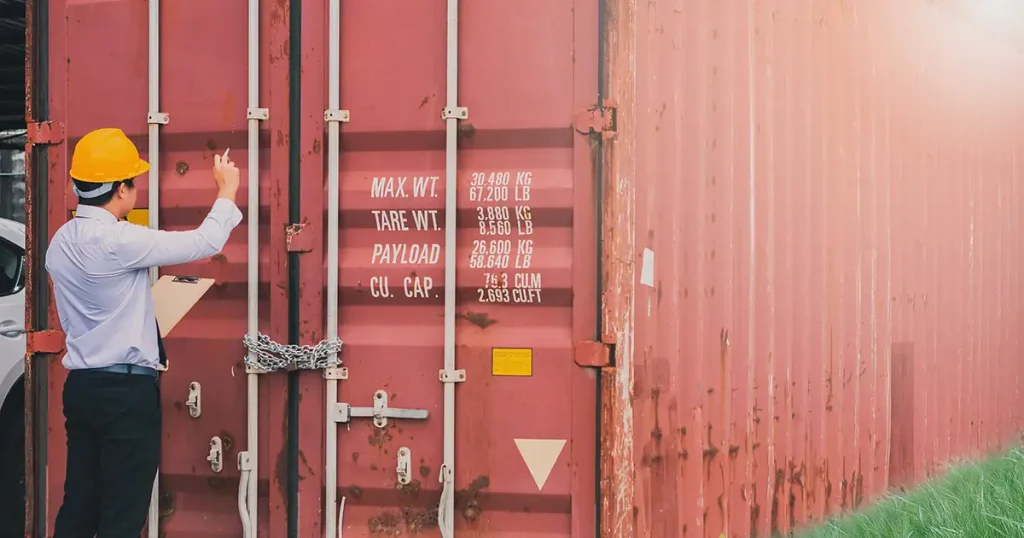
The inspection checklist
Work from the top down and from the outside in. Bring a torch, a screwdriver and a phone camera, and if you can, inspect on a dry, bright day.
| Area | What to check | Walk away if |
|---|---|---|
| Roof | Dents, standing water, rust patches; look from a ladder or ask for a roof photo | Rust holes or deep dents that pond water |
| Side and end walls | Dents, patched panels, weld repairs, bulges | Holes, or fresh paint hiding patches you cannot inspect |
| Doors | Both open fully, locking bars turn and seat in their keepers, hinges move freely | Doors that need a bar to shift, missing locking gear |
| Door gaskets | Rubber seals soft and continuous around both doors | Split, flattened or missing seals (unless priced in) |
| Floor | Firm underfoot, no soft spots, no strong smell | Rotten sections, chemical or fuel smells, oil soaking |
| Underside | Cross members and forklift pockets straight; rust only on the surface | Cross members rusted through or bent |
| Corner posts and castings | Square and straight, no cracks, no heavy flaking rust | Cracked castings, posts bent out of line |
| Light test | Close yourself inside on a bright day and look for light | Any light through the roof or walls |
| Plates and numbers | CSC plate present; container number matches the listing and invoice | Number missing, ground off or not matching |
The CSC plate and container number
Every container built for sea freight carries a CSC safety approval plate under the International Convention for Safe Containers. It is usually fixed to the left-hand cargo door. The plate shows the manufacture date, identification number, maximum gross weight and allowable stacking and racking loads. If a seller describes a container as cargo-worthy, the plate must also show a current examination date or approved continuous examination programme (ACEP) reference.
The container number on the doors and sides follows ISO 6346: a four-letter owner code ending in U, six digits and a final check digit. It should match the CSC plate, the listing and your invoice. A seller who will not give you the number before you pay is a warning sign. For storage on land a CSC plate is not a legal requirement, but it is the most reliable record of the container’s age.
If you need the container to carry cargo by sea again, our guide to container certification and CSC plates explains examination dates and recertification.
Buying a container on Trade Me
Trade Me is New Zealand’s main marketplace for containers, with trade sellers and private sellers listed side by side. A trade seller is covered by the Fair Trading Act and, if you buy for personal use, the Consumer Guarantees Act. Private sales are not covered by the Consumer Guarantees Act, so your inspection is your protection.
- Check the seller’s feedback and how long the account has been active.
- Ask whether the price includes GST and whether you will receive a tax invoice. Trade sellers on Trade Me generally show GST-inclusive prices.
- Confirm the pick-up location and who loads the container. Many listings state that a swinglift or HIAB is needed to uplift it.
- View the container, or ask someone local to view it for you.
- Keep messages on Trade Me so there is a record of what the seller said.
Container scam warning signs
Several large NZ container suppliers publish warnings about container scams, including fake websites and listings. Watch for these signs:
- A price far below the market. The cheapest new 20ft we found in October 2026 was $3,990 incl. GST, and that unit had a dent. A new container offered for much less deserves suspicion.
- A website or listing that copies a real company’s name or photos but gives a different phone number or bank account.
- Payment by bank transfer to a personal account, or in cryptocurrency or gift cards.
- Pressure to pay a deposit today to hold stock, with no viewing allowed.
- No company number, GST number or physical address, or details that do not match the public register.
- Refusal to give the container number before payment.
Look up the business on the New Zealand Companies Office register and call it on a number you find independently. If you think you have been targeted, contact your bank straight away and report it to Netsafe.
Shipping-Containers.co.nz does not sell containers or take payment for them. Suppliers who receive your request quote and invoice you directly. Read how our quote service works.
How to verify the seller
NZ Police in the Eastern District warned in April 2024 about shipping containers advertised on Facebook Marketplace and community pages that did not exist. The sellers asked for payment plus a delivery fee, offered a discount for paying quickly and then blocked the buyers. (NZ Police)
Shipping container seller verification takes a few minutes and is worth doing for every private or unfamiliar seller:
- Look the business up on the NZ Companies Office register and check the name matches the bank account you are asked to pay.
- Ask for a current photo or short video of the actual unit with the container number visible, and check the number on delivery.
- View the container at the yard if you can, or ask the seller to confirm the yard address.
- Be wary of prices well below the NZ price index and of pressure to pay a deposit today.
- Pay by bank transfer to a business account in the seller’s name, never by gift cards or crypto, and keep the written invoice.
If you have been caught out, report it to Police on 105 or at 105.police.govt.nz.
Paperwork to hold when you pay
- A written quote or tax invoice naming the seller, their GST number if GST registered, the container size, grade and container number.
- Known defects listed in writing.
- Delivery terms: who delivers, which truck, the date, what happens if the truck cannot reach the site, and any waiting time charges.
- Payment terms and when ownership passes to you.
- Photos of the actual container taken before it leaves the yard.
Under the Fair Trading Act, a quote or estimate can be misleading if the final cost ends up much higher than you were led to expect, so ask for the container, delivery, any crane work and GST to be shown separately.
On delivery day
Check the container before you sign for it, using the same list as above. Make sure the driver sets it level on firm supports, such as sleepers or pads under the corner castings, so the doors stay square and the base can dry. Our guide to container foundations covers the options. If the container sits within 500 m of the coast, plan early touch-ups using our rust and coastal corrosion guide.
For more on condition and price ranges, see used shipping containers. When you are ready, request quotes from suppliers who service your area through our quote form.
Get quotes from suppliers who service your area
Describe the size, grade and delivery address. Suppliers quote you directly, so you can ask for photos, the container number and written terms before you commit.
Get a free quoteFAQ
Buying a used container: common questions
Start with the roof, because dents that hold water lead to rust holes. Then check that both doors open and seal, the floor is firm and odour-free, the corner posts and cross members are straight, and no light shows through the walls when you stand inside with the doors shut. Confirm the container number matches the paperwork.
It can be, if you take the usual precautions. Check the seller’s feedback, view the container or have someone view it for you, confirm the container number and keep messages on Trade Me. Ask whether the price includes GST and who arranges loading. Private sales are not covered by the Consumer Guarantees Act, so inspect carefully before you pay.
Be wary of prices far below the market, pressure to pay a deposit immediately, payment to a personal bank account, no physical address or company number, and refusal to let you view the container or give its number. In October 2026 the cheapest new 20ft we found in NZ was $3,990 incl. GST, and it had a dent.
The CSC safety approval plate is usually fixed to the outside of the left-hand cargo door. It shows the manufacture date, identification number, maximum gross weight and stacking load. Older or repainted containers sometimes have a worn or painted-over plate. Ask the seller for a clear photo of it before you buy.
Not for storage on land. The CSC plate matters for containers used in international transport, where it must be valid and current. For a container that will sit on a farm, a site or a section, the plate is useful as a record of its age and identity, but a missing plate does not stop you using it for storage.
A deposit is normal with established suppliers, especially for modified containers. Pay it only after you have confirmed the business on the Companies Office register, called them on a number you found yourself, and received a written quote showing the container, grade, delivery and GST. Avoid paying into personal accounts or by gift cards or cryptocurrency.
Hiring a shipping container costs less for short jobs, and buying costs less once you need the box for long enough. The question is where the line sits. Using the median hire rate and median purchase prices from the Shipping-Containers.co.nz NZ price index, October 2026, a used 20ft becomes cheaper to buy than to hire after about 20 months once delivery and pick-up are counted. A new 20ft takes about 26 to 27 months. The tables below show the arithmetic so you can redo it with your own quotes.
The figures we used
- Hire: $145 a month for a 20ft, the median of six published on-site hire rates from five NZ suppliers (range $90 to $276, GST excluded or not stated).
- Used purchase: $3,200 excl. GST, the median for a used wind and watertight or B grade 20ft (15 data points).
- New purchase: $4,200 excl. GST, the median for a new or one-trip 20ft (51 data points).
- Transport: $360 excl. GST per move, the published starting price for hire delivery from one West Auckland yard to nearby suburbs. We apply it to every move, so hire carries two moves (delivery and pick-up) and purchase carries one (delivery).
All figures are excl. GST. If you are not GST-registered, every figure rises by 15%, but the break-even month stays the same because GST applies to both sides. We have not assumed any resale value for a purchased container; if you sell it afterwards, buying wins sooner.
| Scenario | Purchase price | Monthly hire | Calculation | Break-even |
|---|---|---|---|---|
| Used 20ft vs median hire | $3,200 | $145 | 3,200 ÷ 145 | 22.1 months |
| New 20ft vs median hire | $4,200 | $145 | 4,200 ÷ 145 | 29.0 months |
| New 20ft vs new-grade hire | $4,200 | $175 | 4,200 ÷ 175 | 24.0 months |
| Used 20ft vs lowest published hire | $3,200 | $90 | 3,200 ÷ 90 | 35.6 months |
| Used 20ft vs highest published hire | $3,200 | $276 | 3,200 ÷ 276 | 11.6 months |
| Used 40ft B grade vs used 40ft hire | $3,043 to $4,400 | $170 | 3,043 ÷ 170 to 4,400 ÷ 170 | 17.9 to 25.9 months |
Adding delivery and pick-up
Transport changes the answer, because hire involves two truck movements and buying involves one. With $360 per move, hiring a 20ft for any period costs $145 times the number of months plus $720. Buying a used 20ft costs $3,200 plus $360, which is $3,560. Buying a new one costs $4,200 plus $360, which is $4,560.
The break-even month is the point where the hire total reaches the purchase total:
- Used 20ft: (3,560 minus 720) ÷ 145 = 2,840 ÷ 145 = 19.6 months.
- New 20ft: (4,560 minus 720) ÷ 145 = 3,840 ÷ 145 = 26.5 months.
| Months needed | Hire total | Buy used total | Buy new total | Cheapest |
|---|---|---|---|---|
| 3 | $1,155 | $3,560 | $4,560 | Hire |
| 6 | $1,590 | $3,560 | $4,560 | Hire |
| 12 | $2,460 | $3,560 | $4,560 | Hire |
| 18 | $3,330 | $3,560 | $4,560 | Hire |
| 24 | $4,200 | $3,560 | $4,560 | Buy used |
| 36 | $5,940 | $3,560 | $4,560 | Buy used |
Reading the results
For anything up to about 18 months, hire was cheaper in every scenario built on the median rate. That covers most house moves, renovations and building projects. Between about 18 months and two years the two options are close, and details decide it: a low hire rate, a long minimum term, a cheap local delivery or a buyer for the container at the end. Beyond two years, buying a used container is clearly cheaper, and a new one passes the hire total at about 26 to 27 months.
The spread of published rates matters as much as the median. At the lowest published rate of $90 a month the simple break-even for a used 20ft stretches to 35.6 months. At the highest, $276 a month, it falls to 11.6 months. Before you decide, get a real hire rate and a real purchase price for your address. Our shipping container hire guide lists what to ask hire suppliers, and the shipping container price guide explains how to compare purchase quotes.
Minimum terms can change the maths
Published minimum hire terms ranged from one month to 12 months. The lowest daily rate we found, $3.04 a day excl. GST for a 20ft, came with a 12-month minimum. For a four-month job that means paying for twelve. Always cost the hire over the longer of your expected period and the minimum term.
Transport is not the same everywhere
We used $360 per move because it is a published Auckland figure. On a rural property or a long run from the depot, each move can cost much more, and that pushes the break-even earlier because hire pays for two moves. Our guide to shipping container transport costs in NZ collects the published examples.
Costs that are not in the tables
- Resale value. A container you own can be sold when you no longer need it. Used 20ft containers were advertised at a median of $3,680 incl. GST in October 2026, but what you get depends on condition, demand and who pays to move it.
- Removal. If you buy and later want the container gone, you pay for a truck again unless the buyer collects it.
- Condition risk. When you hire, the supplier provides a usable container. When you buy used, you take on the condition, so inspect it or ask for photos of the actual unit. Our grades guide explains the labels.
- Modifications. You cannot usually cut a roller door or windows into a hired container. If you plan any change, buy.
- Placement rules. A container that stays on your section for years is more likely to draw attention under the district plan than one hired for a few months. Check council rules for long-term placement.
When hire makes sense
Hire suits a defined project: a house move, a renovation, a building site, an event or a harvest season. It also suits builders who move from site to site, because the supplier handles the logistics; see site storage and workshop containers for typical set-ups.
When buying makes sense
Buy when you need storage for two years or more, when the container will become a workshop, sleepout or farm store, or when you want to modify it. A sound used shipping container is the cheapest long-term option for storage, while a new or one-trip container suits fit-outs and visible locations.
Rent-to-own
Some NZ suppliers offer rent-to-own agreements, where you pay a monthly amount and own the container at the end of the term. These can help if you want a container now but prefer to spread the cost. Ask for the total you will pay over the full term, how much of each payment goes toward the purchase, who insures the container during the term and what happens if you stop early. Compare that total with the purchase price plus delivery from the tables above; the difference is what you pay for spreading the cost.
Get hire and purchase prices for the same address
The cleanest way to decide is to compare a real hire quote with a real purchase quote for your site. Tell us the size, the period and the address, and suppliers who service your area quote you directly.
Get a free quoteFAQ
Hire vs buy questions
It depends on how long you need it. Using October 2026 medians and $360 per truck move, hiring a 20ft was cheaper for anything up to about 19 months, and buying a used 20ft was cheaper after about 20 months. A new 20ft became cheaper than hiring after about 26 to 27 months. Get real quotes for your address to confirm.
Published on-site hire rates for a 20ft ran from $90 to $276 a month in October 2026, with a median of $145, GST excluded or not stated. Newer containers cost more to hire than used ones. Published 40ft rates ran from $129 to $260 a month excl. GST. Delivery and pick-up are charged separately on top of the monthly rate.
Not in any published rate we found. Expect a delivery fee at the start and a pick-up fee at the end. One West Auckland yard publishes delivery from $360 + GST to nearby suburbs and $160 + GST per hour further afield. On a short hire, those two fees can cost more than the rent itself.
You pay a monthly amount for an agreed term, and the container becomes yours at the end. Terms differ by supplier, so ask for the total payable, the share of each payment that counts toward the purchase, insurance arrangements and early exit costs. Compare the total with the purchase price plus delivery to see what spreading the cost adds.
Yes. Used containers are listed on Trade Me and sold through suppliers, and used 20ft units in B grade were advertised at a median of $3,680 incl. GST in October 2026. What you receive depends on the container’s condition, your location and who pays for transport. Any resale value makes buying cheaper than our tables show.
Since 15 January 2026, a small standalone dwelling of up to 70 m² can be built in New Zealand without a building consent, provided it meets the conditions in Schedule 1A of the Building Act. The change came from the Building and Construction (Small Stand-alone Dwellings) Amendment Act 2025, and MBIE’s granny flats guidance (version 2) reflects amendments to Schedule 1A that took effect on 8 October 2026. On the planning side, a national environmental standard now permits these units in most zones.
Many people ask whether a converted shipping container can use the exemption. MBIE’s guidance does not mention shipping containers, and the exemption is written around lightweight framing. Our view is that you should plan a container granny flat as a consented build unless your council confirms in writing, through the project information memorandum (PIM), that your design is likely to meet Schedule 1A. This guide explains the conditions, the process and the reasons for that caution.
What the exemption requires
| Condition | Requirement |
|---|---|
| Floor area | 70 m² or less, including any internal garage |
| Distance | At least 2 m from any other residential building or legal boundary |
| Form | New, standalone, single storey, no mezzanine, one household |
| Height | Floor no more than 1 m above ground; no more than 4 m above floor level |
| Design | Simple design |
| Structure | Light timber framing or light steel framing, or a certified composite structural building product |
| Cladding weight | Roof cladding up to 20 kg/m²; wall cladding up to 220 kg/m² |
| Wet areas | No level-entry shower that needs a waterproof membrane |
| Heating | Electric or gas only, no solid fuel |
| Services | Connected to network utility services where available, otherwise compliant on-site systems |
| People | Designed and built, or supervised, by LBPs; registered plumbers and drainlayers; licensed electrical and gas workers |
What changed on 8 October 2026
Version 2 of the MBIE guidance covers amendments to Schedule 1A from 8 October 2026. They allow certified composite structural building products as an alternative to light timber or light steel framing, and clarify the rules on connections to network utility services and on-site water, wastewater and stormwater systems. The basic limits on size, distance, height and professionals did not change.
The PIM process
- Apply to the council for a PIM on Form 2AA before any work starts.
- The council issues Forms 2AAB and 2AAC and says whether the work is “likely”, “likely not” or “unclear” to meet the exemption.
- A development contribution notice (Form 3A) comes with the PIM. Simpli says contributions are payable within 20 days of completion; Central Otago says as notified.
- Build within 2 years of the PIM being issued.
- Lodge completion documents within 2 years of the PIM or 20 working days of completion, whichever comes first: as-built plans, the LBP certificate of design work, records of building work, plumbing and drainlaying records, the electrical safety certificate and any gas certificates. They go on the property file and the LIM.
MBIE does not set a fee. Councils charge for the PIM, and development contributions vary by council.
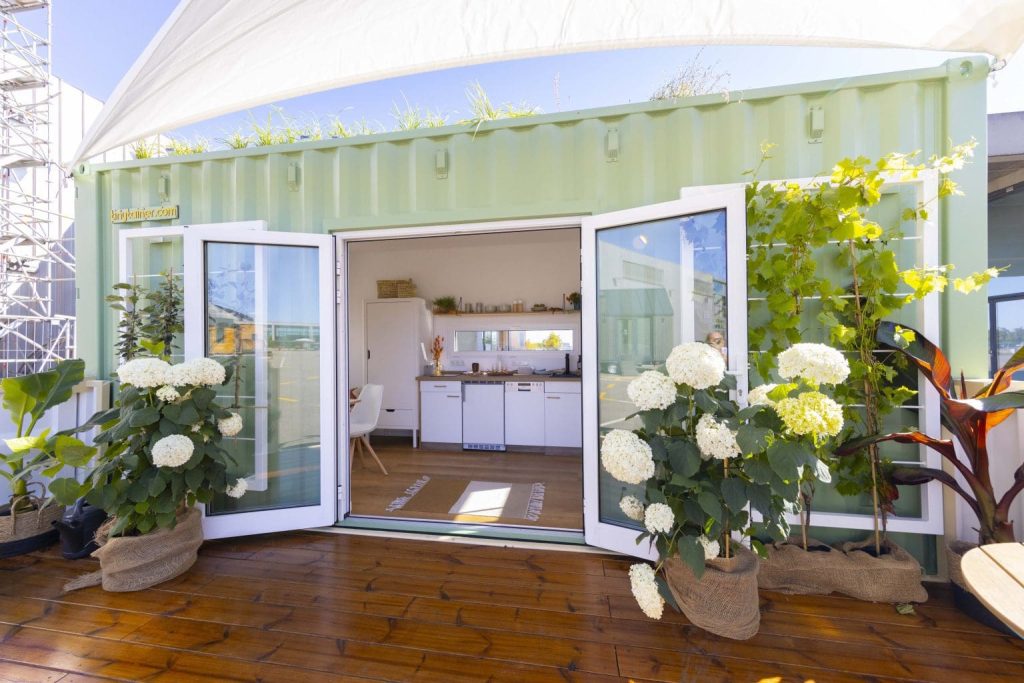
The planning side: NES-DMRU
The National Environmental Standards for Detached Minor Residential Units took effect on 15 January 2026. A unit of up to 70 m² is a permitted activity in residential, rural, mixed use and Māori purpose zones if it meets the standards. A September 2026 amendment says setbacks are measured from the exterior face of the external wall. The standards do not care what the unit is built from, so they can apply to a consented container unit too. Western Bay of Plenty District Council lists these standards:
| Standard | Requirement |
|---|---|
| Principal dwelling | An existing principal dwelling on the site; one minor unit per site |
| Size | Up to 70 m² |
| Separation | 2 m from the principal unit |
| Residential zones | 2 m from all boundaries; site coverage up to 50% |
| Rural zones | 10 m front setback; 5 m side and rear |
| Overlays | Still apply: heritage, natural hazards, special natural feature areas, reverse sensitivity, contaminated land |
| Not covered | Sheds and sleepouts that are not self-contained |
Why a container conversion probably needs full consent
- The structure condition names light timber framing, light steel framing or a certified composite product. A shipping container is a structural shell of corrugated weathering steel, with a tare of about 2.2 tonnes for a 20ft unit. It does not obviously fit any of those categories.
- MBIE’s designers’ guide does not mention shipping containers. It refers to factory-built units only in the PIM context, as a dwelling “constructed in a factory and then transported to the final site”.
- Cutting windows and doors into a container calls for engineered steel framing, which sits uneasily with the “simple design” condition.
- If the council’s PIM says “likely not” or “unclear” and you build anyway, you carry the risk of a notice to fix.
This is our reading of the rules, not a ruling by MBIE or a council. A design professional may present a container-based design to the council, and the PIM answer is what counts. If the answer is not “likely”, apply for a building consent: our guide to container homes in NZ covers that route, and our consent guide explains the smaller Schedule 1 exemptions.
Workable alternatives
- Build the granny flat in light timber or light steel framing under the exemption, and use a container next to it for storage. A container simply placed for storage is not building work; see containers for home storage.
- For a bedroom without a kitchen or bathroom, look at a container sleepout, which follows different rules.
- For a full container dwelling, follow the building consent route with an LBP designer and engineer. Our tiny homes and off-grid page covers shell choice and services.
Steps before you buy a container
- Read the MBIE guidance and your council’s granny flat page.
- Check your zone against the NES-DMRU standards and any overlays.
- Engage an LBP designer and ask for a PIM before you buy shells.
- Once the route is clear, request quotes for the containers with the size, grade and delivery address.
Route confirmed with council?
When your designer has settled the shell sizes, send us the specification and delivery address and suppliers will quote directly.
Get a free quoteFAQ
Granny flat exemption questions
Not with any certainty. Schedule 1A requires light timber framing, light steel framing or a certified composite structural product, and MBIE’s guidance does not mention containers. A container shell does not obviously fit. Apply for a PIM before you start: unless the council says your design is “likely” to meet the exemption, treat the project as needing a full building consent.
Often not. Under the NES for Detached Minor Residential Units, in force since 15 January 2026, a unit of up to 70 m² is permitted in residential, rural, mixed use and Māori purpose zones if it meets the standards, such as boundary setbacks and one unit per site. Overlays such as heritage or natural hazards still apply. Check your council’s page.
The building consent exemption requires at least 2 m from any other residential building or legal boundary. The planning standards set their own setbacks: in Western Bay of Plenty’s version, 2 m from all boundaries in residential zones and 10 m front, 5 m side and rear in rural zones. Since September 2026 setbacks are measured from the exterior face of the external wall.
Two years from the date the PIM is issued. Completion documents, including the LBP certificate of design work, records of building work, plumbing and drainlaying records and the electrical safety certificate, are due within 2 years of the PIM or within 20 working days of completion, whichever comes first. They are placed on the property file and the LIM.
Yes, where your council charges them. A development contribution notice (Form 3A) is issued with the PIM. Simpli guidance says contributions are payable within 20 days of completion, and Central Otago says they are payable as notified. Amounts vary widely between councils, so ask for an estimate before you commit to the project.