



Shipping Container Dimensions, Sizes and Weight
External and internal sizes, door openings, volume and weights for every common container sold in New Zealand, from 8ft minis to 40ft high cubes. Use these figures to plan your site and contents, then confirm the actual unit with the supplier before you rely on a tight fit.
Backed by the team behind Shipping-Containers.com.au



How to read these tables
The external length, width and height of 20ft and 40ft containers are fixed by the ISO standard, so every standard box fits the same trucks, ships and twistlocks. Internal dimensions, door openings and weights are not fixed. They depend on the wall corrugation, floor thickness, door frame and the manufacturer, and they differ by a few millimetres to a few centimetres between units. The figures below are typical values for dry (general purpose) containers. The 8ft and 10ft sizes are not standard shipping sizes at all: most are built new for storage or cut down from 20ft containers, so they vary more. Where the fit matters, ask the supplier for the specification sheet or the CSC plate details of the unit you are buying. Our Australian sister site also publishes size charts for 8ft to 40ft containers.
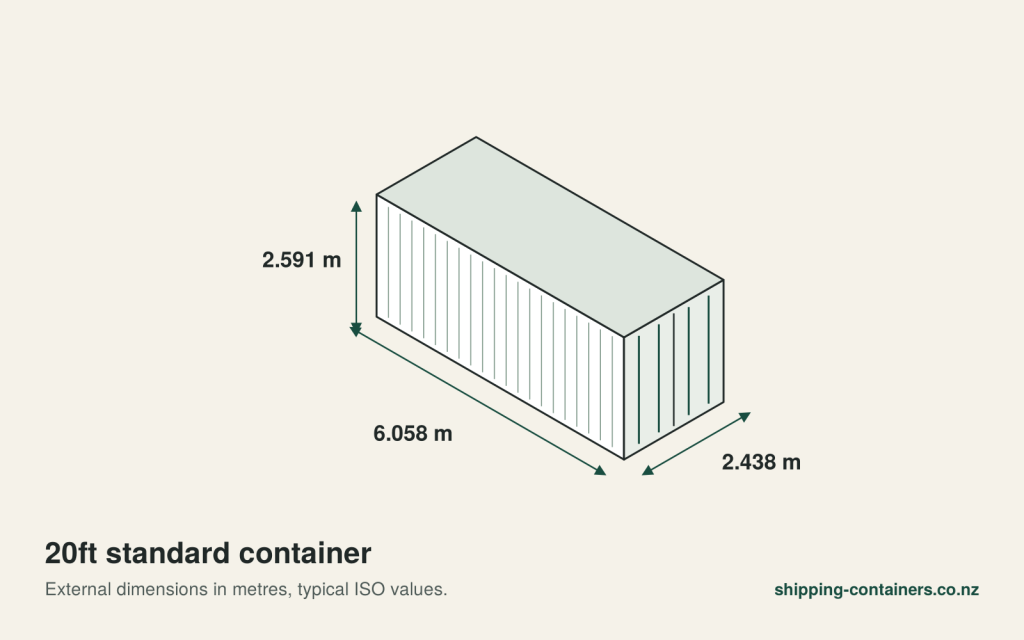
| Container | Length | Width | Height | Footprint |
|---|---|---|---|---|
| 8ft new-build mini | 2.438 | 2.200 | 2.260 | 5.4 m² |
| 8ft cut-down | 2.438 | 2.438 | 2.591 | 5.9 m² |
| 10ft | 2.991 | 2.438 | 2.591 | 7.3 m² |
| 20ft standard | 6.058 | 2.438 | 2.591 | 14.8 m² |
| 20ft high cube | 6.058 | 2.438 | 2.896 | 14.8 m² |
| 40ft standard | 12.192 | 2.438 | 2.591 | 29.7 m² |
| 40ft high cube | 12.192 | 2.438 | 2.896 | 29.7 m² |
| Container | Length | Width | Height | Floor area | Volume |
|---|---|---|---|---|---|
| 8ft new-build mini | about 2.28 | about 2.11 | about 2.06 | about 4.8 m² | about 9.9 m³ |
| 8ft cut-down | about 2.28 | 2.352 | 2.393 | about 5.4 m² | about 12.8 m³ |
| 10ft | about 2.83 | 2.352 | 2.393 | about 6.7 m² | about 15.9 m³ |
| 20ft standard | 5.898 | 2.352 | 2.393 | 13.9 m² | 33.2 m³ |
| 20ft high cube | 5.898 | 2.352 | 2.698 | 13.9 m² | 37.4 m³ |
| 40ft standard | 12.032 | 2.352 | 2.393 | 28.3 m² | 67.7 m³ |
| 40ft high cube | 12.032 | 2.352 | 2.698 | 28.3 m² | 76.3 m³ |
What the numbers mean
Three measurements buyers often get wrong
The door is smaller than the inside
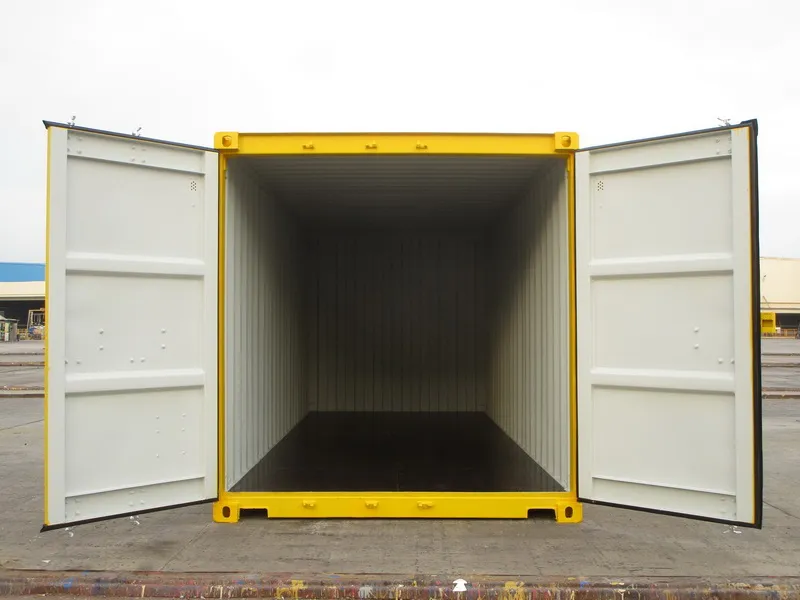
The door frame and locking gear take up space, so a standard container’s door opening is about 2.34 metres wide and 2.28 metres high, about 11 cm lower than the ceiling inside. A high cube’s door is about 2.585 metres high. For vehicles, machinery and tall pallet loads, the door is usually the limit, not the inside. Compare high cube containers if your load is close to 2.28 metres.
Width is lost at the corrugations
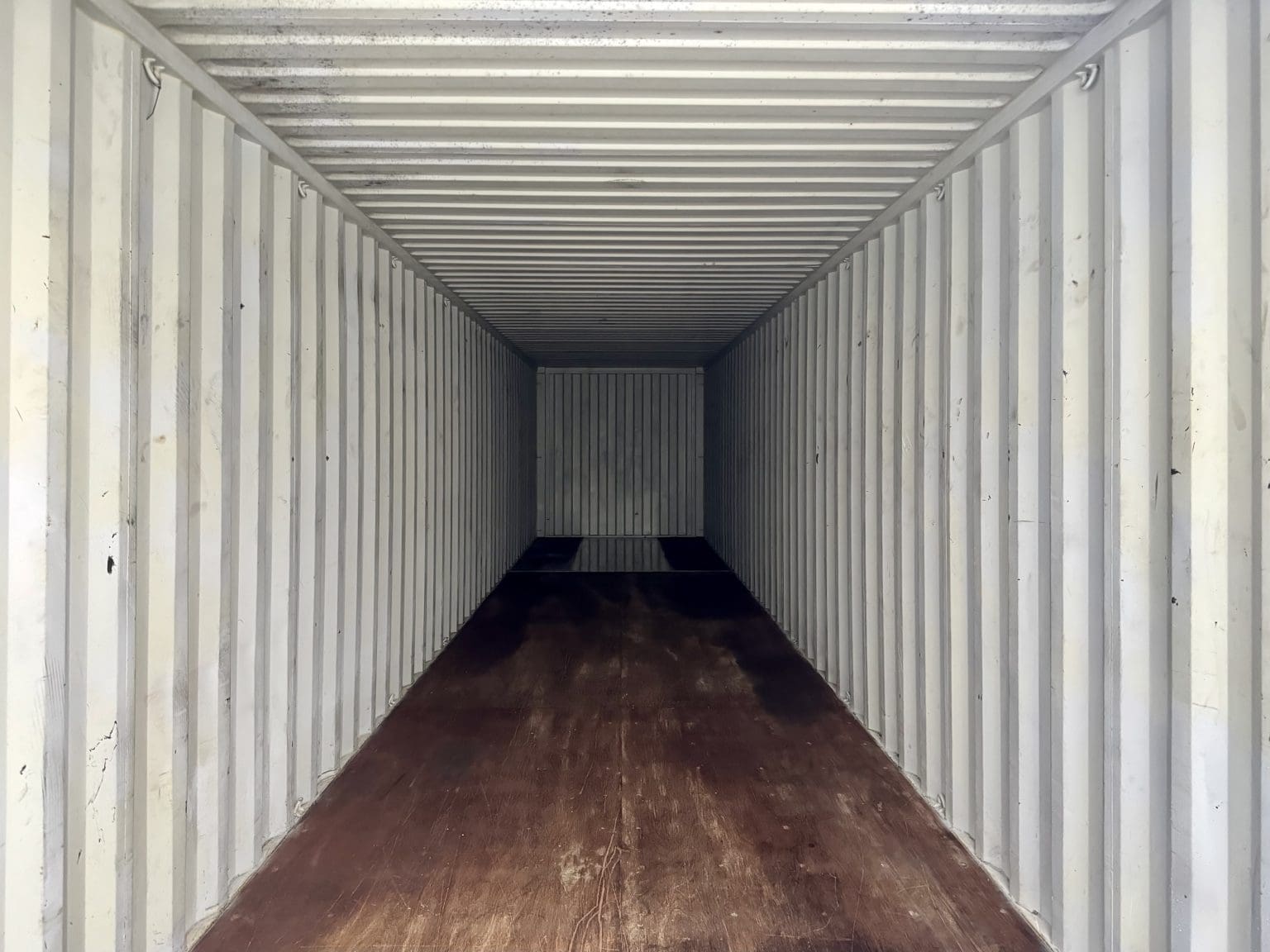
Container walls are corrugated steel. The internal width of 2.352 metres is typically measured at the narrowest point, and lining or shelving fixed to the walls reduces it further. Two standard NZ 1165 mm pallets side by side need 2.33 metres, so they fit across a 20ft or 40ft with only a couple of centimetres to spare. That gives ten pallets in a 20ft and twenty in a 40ft. Our Australian site explains how to load a container properly, including weight distribution and securing the load.
Usable height after a fit-out
If you plan to insulate, line or add a new floor, deduct the build-up. With 100 mm of ceiling insulation and a new floor, a standard container’s 2.39 metres falls to roughly 2.2 metres and a high cube’s 2.70 metres to about 2.5. For sleepouts, offices and homes, that difference is why most designs start with a high cube. See our standard vs high cube guide.
| Container | Door width x height | Tare weight | Maximum gross weight |
|---|---|---|---|
| 8ft new-build mini | about 1.95 x 2.00 (varies) | about 900 to 1,100 kg | storage unit, not usually CSC-rated |
| 8ft cut-down | 2.340 x 2.280 | about 1,000 to 1,300 kg | storage unit, not CSC-rated after cutting |
| 10ft | 2.340 x 2.280 | about 1,200 to 1,500 kg | about 10,000 kg where rated |
| 20ft standard | 2.340 x 2.280 | about 2,150 to 2,350 kg | 24,000 kg (older) to 30,480 kg |
| 20ft high cube | 2.340 x 2.585 | about 2,350 to 2,500 kg | usually 30,480 kg |
| 40ft standard | 2.340 x 2.280 | about 3,650 to 3,800 kg | 30,480 to 32,500 kg |
| 40ft high cube | 2.340 x 2.585 | about 3,800 to 4,000 kg | 30,480 to 32,500 kg |
Choosing a size from the dimensions
Start with what has to go inside. Measure the largest items at their widest and tallest points, then check them against the door opening rather than the internal size. Add an aisle of at least 60 to 80 cm if you need to reach the back regularly. As a rough guide, a 10ft holds the contents of a one bedroom flat, a 20ft the contents of a two or three bedroom house, and a 40ft a larger house, a farm machinery store or bulk stock. Our size guide goes through common loads in more detail.
Then measure the site. The container needs its footprint plus room for the doors to swing open, about 1.2 metres in front of a standard door pair. The truck needs much more: access width of about 3.5 to 4 metres, firm ground, clear air above the lift and, for a swinglift, a strip about 4 to 5 metres wide alongside the container. Our delivery guide explains what each truck needs.
Before you order
Measurements to send with a quote request
Your largest item
Give the length, width and height of the biggest thing that must go in, including mirrors, roll bars or handles. If it is close to 2.28 metres high or 2.34 metres wide, say so in your quote request, and suppliers can quote a high cube or confirm the door opening of the actual unit.
The placement area
Measure the spot where the container will sit and the clear space in front of the doors. Note the slope across and along the area. A fall of more than a few centimetres over the container’s length needs packing or a pad, so suppliers will want to know before delivery day.
The access route
Measure the narrowest point on the way in, usually a gate or a gap between buildings, and the height of any branches, carports or power lines the truck must pass under. Photos from the street and from the placement spot help suppliers choose a HIAB, swinglift or tilt tray.
Weight limits
If the container will sit on a deck, a retaining wall or soft ground, or you plan to move it with your own equipment, check the tare weight and the loaded weight. Our guide to shipping container weight explains tare, payload and corner loads.
Have a dimension that has to work?
Tell us the minimum internal size, door clearance or footprint your project needs and the delivery address. Suppliers can confirm the actual unit’s measurements in their quote.
Get a free quoteFAQ
Container dimensions: common questions
Shipping container capacity in m3 is the internal volume. A 20ft standard holds about 33.2 m³, a 20ft high cube about 37.4 m³, a 40ft standard about 67.7 m³ and a 40ft high cube about 76.3 m³. A 10ft holds roughly 16 m³. Usable capacity is lower once you allow for pallets, racking and an access aisle.
A standard 20ft container is 6.058 metres long, 2.438 metres wide and 2.591 metres high outside. Inside it is about 5.898 by 2.352 by 2.393 metres, giving 13.9 m² of floor and 33.2 m³ of volume. The door opening is about 2.34 metres wide and 2.28 metres high. A 20ft high cube has the same length and width but is 2.896 metres high outside.
A standard 40ft container is 12.192 metres long, 2.438 metres wide and 2.591 metres high outside. Inside it measures about 12.032 by 2.352 by 2.393 metres, giving 28.3 m² of floor and 67.7 m³ of volume. A 40ft high cube is 2.896 metres high outside and about 2.698 metres inside, with 76.3 m³ of volume.
Almost. A 20ft container is 6.058 metres, which is 19 feet 10.5 inches. The length is set slightly under 20 feet so that two 20ft containers joined with the gap used on ships occupy the same space as one 40ft at 12.192 metres. Width is exactly 8 feet (2.438 metres) and standard height is 8 feet 6 inches (2.591 metres).
The ISO standard fixes the outside dimensions and corner fittings, not the inside. Wall corrugation depth, floor thickness, roof bows and door frames differ between factories and production years, so internal sizes vary by a few millimetres to a few centimetres. Cut-down 8ft and 10ft units vary more, because each supplier cuts and finishes them differently. Ask for the actual unit’s figures for any tight fit.
A typical 10ft container is 2.991 metres long, 2.438 metres wide and 2.591 metres high outside, with about 2.83 by 2.35 by 2.39 metres inside. That gives about 6.7 m² of floor and 15.9 m³ of space. The door opening is the same as a 20ft at about 2.34 by 2.28 metres. Cut-down units can be a few centimetres shorter inside.
For the container itself, its footprint plus about 1.2 metres in front of the doors so they open fully, and room to walk around it for maintenance. Delivery needs far more: about 3.5 to 4 metres of access width, firm ground and clear air above the lift. Exempt buildings of 10 to 30 m² must be at least 1 metre from a boundary, and your district plan may set larger yards.