



A 40ft container gives you about twice the floor area of a 20ft, usually for well under twice the price. It also needs twice the length on site and a bigger truck to deliver it. This guide compares the two sizes on space, NZ prices per square metre, delivery and placement, so you can decide which suits your section, farm or building site, or whether two 20ft containers would work better.
The two sizes side by side
Both sizes share the same width and, in standard form, the same height. The 40ft is simply twice as long. Most new 40ft containers sold in New Zealand are high cubes, so the table includes that version too.
| 20ft standard | 40ft standard | 40ft high cube | |
|---|---|---|---|
| External length | 6.058 m | 12.192 m | 12.192 m |
| External width | 2.438 m | 2.438 m | 2.438 m |
| External height | 2.591 m | 2.591 m | 2.896 m |
| Internal length | about 5.90 m | about 12.03 m | about 12.03 m |
| Internal width | about 2.35 m | about 2.35 m | about 2.35 m |
| Internal height | about 2.39 m | about 2.39 m | about 2.69 m |
| Door opening (W x H) | about 2.34 x 2.28 m | about 2.34 x 2.28 m | about 2.34 x 2.58 m |
| Internal floor area | about 13.9 m² | about 28.3 m² | about 28.3 m² |
| Volume | about 33 m³ | about 67 m³ | about 76 m³ |
| Empty weight (tare) | about 2.2 t | about 3.7 t | about 3.9 t |
| External footprint | about 14.8 m² | about 29.7 m² | about 29.7 m² |
Full measurements for every size, including door openings and high cube variants, are on our shipping container dimensions page, and our Australian site has size charts for 8ft to 40ft containers if you need drawings.
Price and price per square metre
New 20ft containers are the most widely listed unit in New Zealand. New 40ft units are almost all high cubes, and in October 2026 we found no published NZ price for a new standard-height 40ft. Used 40ft listings were fewer and more varied, so the table shows ranges. All figures come from the Shipping-Containers.co.nz NZ price index, October 2026.
| Condition | 20ft | 40ft | Per m² of floor |
|---|---|---|---|
| New or one-trip | median $4,830 (n = 51) | high cube $6,999 to $7,395 (n = 4) | 20ft about $350; 40ft HC about $250 to $260 |
| Used, wind and watertight or B grade | median $3,680 (n = 15) | standard $3,500 to $5,060; high cube $3,000 to $6,595 | 20ft about $265; 40ft standard about $125 to $180 |
On floor area alone, the 40ft is the better buy. The catch is that you only get that value if your site can take a 12 m box and the truck that brings it.
Delivery and site access
A 20ft is the more flexible size on a residential section. HIAB trucks commonly handle 10ft and 20ft containers and can lift over a fence or onto a pad, limited by the crane’s reach and the container’s weight. A 40ft usually arrives on a swinglift, which needs a long, level, firm area beside the truck, roughly the length of the truck and trailer plus about 4 to 5 m of width for the container and stabiliser legs. A tilt tray needs a straight run-off space of about twice the container’s length.
Before you choose 40ft, check gate widths, turning space, slope, overhead power lines, trees and soft ground, especially after a wet winter. Our HIAB vs swinglift guide explains which truck suits which site, and the delivery guide has a full access checklist.
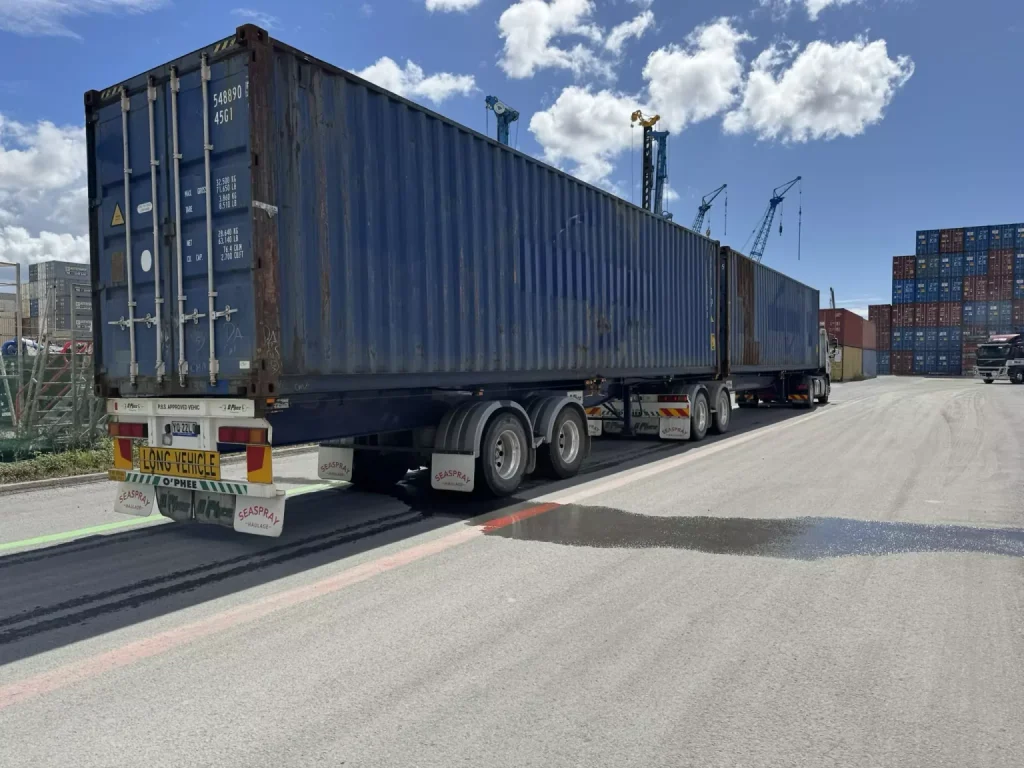
Two 20ft containers or one 40ft
Two new 20ft containers at the median price cost about $9,660 incl. GST, against $6,999 to $7,395 incl. GST for one new 40ft high cube. Two deliveries usually cost more than one as well. Two 20ft boxes still make sense in some cases: they fit tighter access, can be placed in different spots, give you two sets of doors and can be bought one at a time.
A popular layout on NZ farms and lifestyle blocks is two containers with a roof spanning the gap between them, creating covered space for machinery or a workshop. See container shelters for sizes. Be aware that a roof between containers can turn them into a building that needs consent: MBIE determinations have found that container and canopy structures in Hamilton, and two containers joined by an arch in Palmerston North, required building consent.
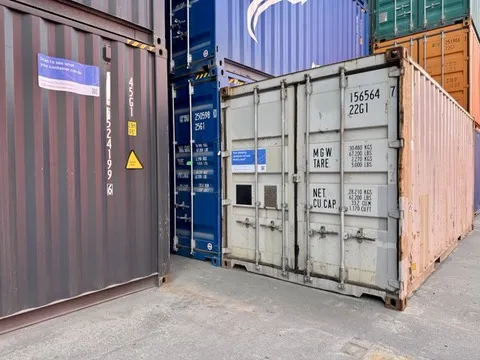
Consent and placement by size
An unmodified container placed on the ground or on sleepers for storage generally involves no building work and needs no building consent, though district plan rules on setbacks, site coverage and visibility from the road still apply. Consent questions start when you add foundations, cut openings, fit it out for people or connect services.
For modified containers, both sizes fall into the 10 to 30 m² band of the Building Act exemptions: about 14.8 m² for a 20ft and about 29.7 m² for a 40ft, measured externally. Since 23 October 2025, buildings in that band using the LBP or engineer-reviewed prefabricated routes must sit at least 1 m from boundaries and residential buildings, under the 2025 exemption order. A 40ft is right at the 30 m² limit, so any addition can push it over. Read our building consent guide and the MBIE list of work that no longer needs consent before you modify either size.
Which size suits which job
- Household storage on an urban section: 20ft. It fits most driveways and HIAB access.
- Moving house or a renovation: a 20ft holds the contents of a typical two to three bedroom home; larger homes may need a 40ft.
- Farm machinery, hay and feed: 40ft, or two 20ft with a shelter roof between them.
- Building site storage and a site office: two 20ft units, placed where each is needed.
- Workshop or long-span storage: a 40ft high cube for the extra headroom.
Our guide to what size container you need has a size chart by use, and our 20ft and 40ft pages list options for each. If you are unsure whether a 40ft will fit, describe the site in your quote request and suppliers can advise on access.
Get quotes for both sizes
Ask for a 20ft and a 40ft in the same request. Tell us the delivery address and any access limits, and suppliers who service your area quote both delivered.
Get a free quoteFAQ
20ft vs 40ft: common questions
Length. Both are 2.438 m wide and, in standard form, 2.591 m high outside. A 20ft is 6.058 m long and a 40ft is 12.192 m long, giving about 13.9 m² and 28.3 m² of internal floor. The 40ft is heavier, needs a larger delivery area and is more often sold new as a high cube.
No. In October 2026 a new 20ft had a median asking price of $4,830 incl. GST, while new 40ft high cubes listed at $6,999 to $7,395 incl. GST. Per square metre of floor, the 40ft costs roughly $250 to $260 against about $350 for the 20ft. Delivery for a 40ft is usually dearer, so compare delivered prices.
One 40ft costs less to buy and usually less to deliver than two 20ft units. Two 20ft containers suit tighter access, can be placed apart, give you two sets of doors and can be bought one at a time. If you plan a shelter roof between them, check consent first, because roofed container structures have needed building consent.
The box is 12.2 m long, but the delivery truck needs much more room. A swinglift needs a long, level, firm area beside the truck plus about 4 to 5 m of width, and clear overhead space. Many urban sections only suit a 20ft placed by HIAB. Describe your access to suppliers and ask them to confirm before you buy.
As a rough guide, a 20ft holds the furniture from a two to three bedroom home and a 40ft from a larger house. Pallet numbers depend on pallet size and how they are loaded. Measure your largest items against the internal width of about 2.35 m and the door height before deciding.